When the Family / Town Secret is You!

My brother and I are perplexed. How is it possible to be in your 40s and only then find out about a family secret that literally everyone knows – all our extended family, all friends of our family, my best friends growing up and an ex-boyfriend I have not talked to for 40 years? It seems, the only 2 people who did not know were me and my brother.

The secret? We did not know that I was adopted until my full sister and a half-sister reached out in 2008, when I was in my mid-forties. They sent me a Facebook message to say, “You don’t know us and we don’t mean to upset you, but we have reason to believe you might be our sister.” First thought? Who are you and what do you want with me?
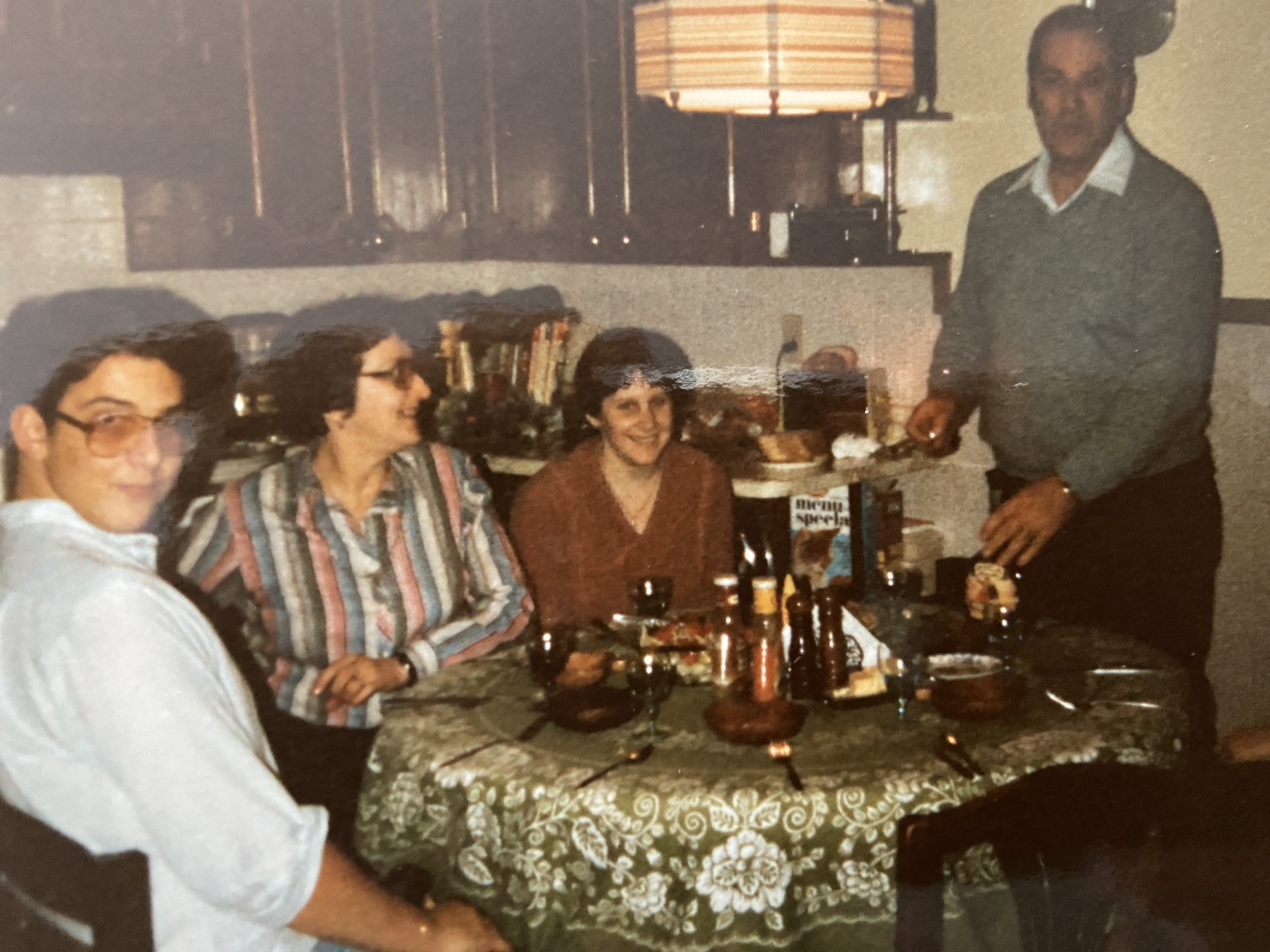
My birthday – probably January 1, 1981 – my brother, mother, me, and dad.

Immediately, I sent this message on to my brother. He has a sharp memory and can recall things I have no idea about. If this was true, surely he would know. He didn’t. He was just as shocked as me. (Also, for those who are wondering, he is the biological son of our parents, born a couple of years after I was in the picture.)

Our first thoughts were that this was an iron clad secret almost nobody knew – otherwise, how was it possible to keep such a secret for over 40 years? Also, it was in the 1960s and social media did not exist. Looking back now, I can see the reasoning was faulty – our parents adopted a child – of course they would have told everyone. So, that explains family and family friends knowing.

Soon after I learned this news, I met up with one of my best friends from high school. I mentioned a sister – thinking I would surprise her. Instead, she surprised me, “Oh, you know.” She had heard through a grapevine. When she asked her mother what she should do, her mother told her it was not her story to tell. True enough.

Then, I discovered some of our cousins knew – which meant all of our cousins knew. My brother and I are among the youngest.

A couple of years ago, a high school classmate died and a few of us gathered to remember him. It was a poignant time. We talked about people we grew up with – including who was adopted or otherwise had different family arrangements. My name was not mentioned in this conversation, nor was I or my situation referenced, nor did anyone ask me anything – even though we all openly knew the background of the people we talked about.
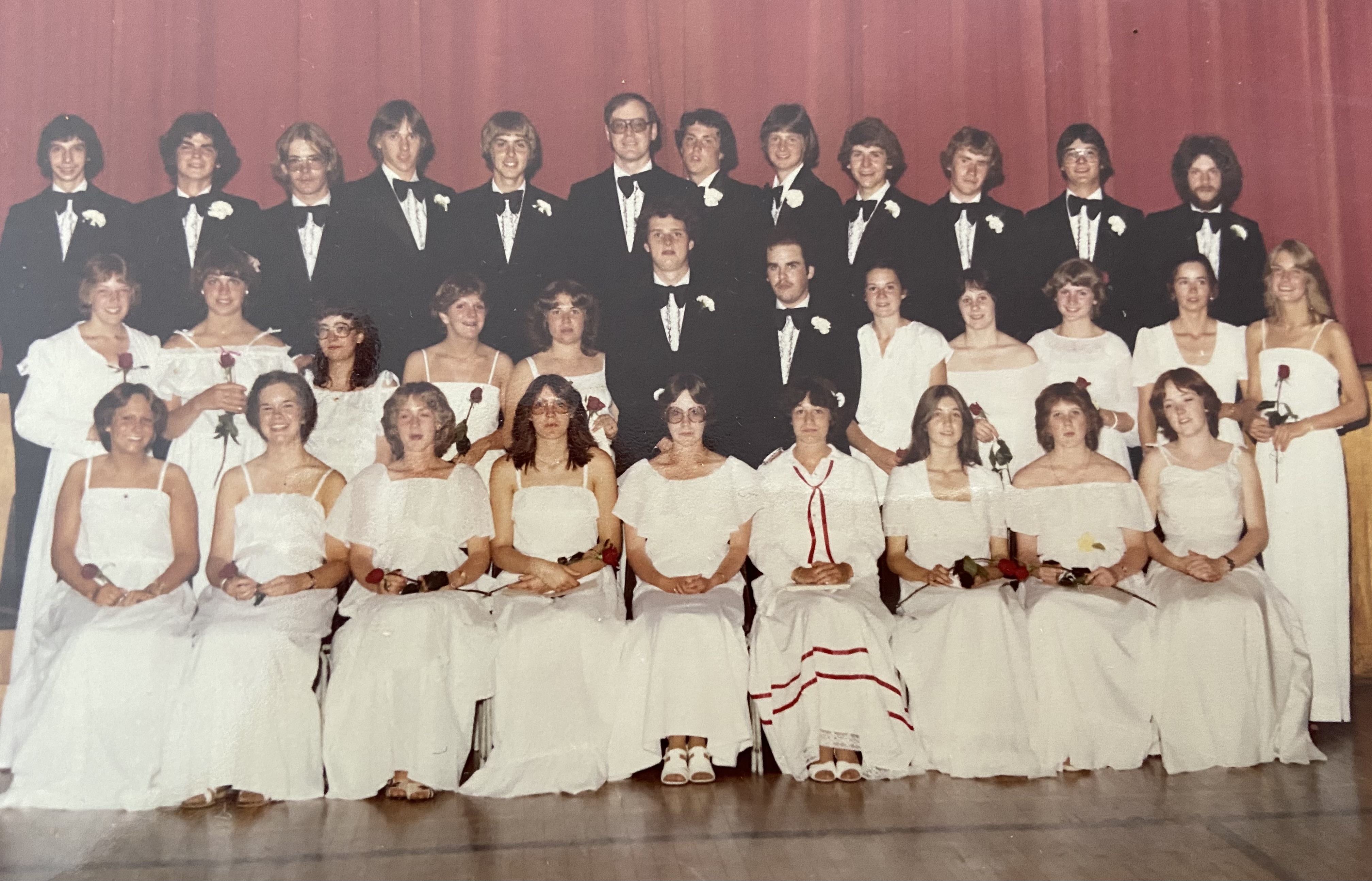
Lunenburg High School Graduation – June 1980.
How many people in this photo knew I was adopted and never said a word?

Later, one of the people there – also a good friend from high school – messaged me about my memoir: Embracing the Stranger in Me: A Journey to Openheartedness in which I write about the unfolding of my adoption story and meeting my birth family. In that exchange, she shared that she knew I was adopted while we were in high school together! Her mother had told her, but now her mother could not recollect how she knew.

I shared this information with my brother. Again, we were equally stunned that people we went to school with knew this about me and our family and it never, ever came up – not in casual conversation, not when talking about other people who were adopted and not in a moment of spite where someone might want to offend you.

This is top of mind at the moment because, recently through a strange kind of delightful serendipity, I reconnected with my high-school sweetheart, my first boyfriend – also, interestingly through FB. As we did the high-level overview of 40 years of life, I mentioned about being adopted. And, he said, he knew! He found out a couple of years after we broke up. The clincher in all of this. My father told his father. They worked together but were not really friends. How on earth did that conversation even come up? And, if my dad could tell my ex-boyfriend’s dad, why couldn’t he tell me? We’ll never know because they are both gone now. Just when you think you can’t be surprised anymore, something else comes to light.

So, it begs the question. How does a whole family and a town not expose a secret, even by accident? How does pretty much everyone we know from that time know about the adoption and it remained a secret to us? Our parents must have had moments of fear, wondering when I – or my brother – was going to come home with questions. Yet, year after year, through university, graduations, career changes, marriage, divorce, remarriage and 3 children of my own, the topic was never brought up.

When it finally did, my mother’s dementia was far enough advanced, it didn’t make sense to try to talk to her about it. Dad and I did have a good conversation – and several after that – and he was supportive of me meeting my birth family, also initially a little worried that this knowledge would affect our relationship. I told him we had 40+ years of relationship – we would be okay. And we were.

It’s a strange world we live in. I do believe secrets want to be revealed. I’m okay with how this story evolved – although it would have been nice to have known my sister earlier. I am curious what would have happened had I heard through one of my classmates – but it’s almost like everyone was sworn to secrecy.

You never know the life path. You never know what is coming up to be cleared anytime but particularly in what had been a very challenging year – 2025 – adding to a 9 in numerology which is a year of endings and clearings – leading into a 1 year – 2026 – for new beginnings, possibilities and opportunities. I have also just left a 9 year behind personally and entered a 1 year personally.

Dear 2026, please be kind, generous and abundant – for us all. I’m ready for it – even as I may never understand how my brother and I were at the heart of a family and town secret that everyone knew except us!

Identity – Reconnecting to Who We at our Core

I’ve been doing a lot of thinking about identity lately – sparked, in part, to recently having a First Person Account published by CBC titled “I had a loving family. My life changed at 46 when my birth sister revealed I was adopted. My parents hid my adoption. But somehow, the truth brought us closer.”

I’ve been doing a series of videos over at the Inner Wisdom Lab Youtube channel where I speak to various aspects of identity and offer a few guided visualizations for anyone looking to connect more deeply to their own core essence. And there are more to come.

I have now known about being adopted for 17 years, which seems a bit incredulous. Finding out sparked an identity expansion in some ways. In a moment, everything changed, yet nothing changed – with respect to my life, my immediate family and my sense of identity.

Identity and Core Essence

In thinking about identity, I am curious about what is underneath personality traits, skills, abilities, life events … and, I have arrived at core essence. The most basic and important attribute of self that provides a sense of who we are, the inner foundation of being. This essence is constant. In this 7 minute video, I speak about core essence or identity and, in this 10 minute one, I offer a guided visualization for anyone wishing to connect with their own sense of identity or core essence.

Identity and Roles

Sometimes we know and sense our core essence with absolute clarity. Other times it is obscured by layers and layers of roles, expectations – our own and others, doubt, hubris, the minutia of life, disappointments and external successes collected over the course of a life journey. We learn to not trust ourselves, our own inner knowing or wisdom or what our highest self whispers to us along the way. I speak about identity and roles in this 12 minute video and offer a 20 minute guided visualization for any wishing to review the timeline of their life, the roles they took on or were thrust upon them, the gifts in the roles and the opportunity to choose to more fully inhabit some roles and shed others that no longer serve.

DNA and Chosen Family Lineages

Perhaps not surprisingly, over the last 17 years I have also thought about lineage – a lot. DNA and chosen family lineage. DNA does not necessarily a family make. As someone who has been adopted, I feel both of these lineages strongly. I imagine there might be others who feel this way – rooted in at least 2 lineages, if not more.

I have felt most closely connected to my chosen family lineage. One could argue that they chose me since I was a baby at the time. But, if you believe in soul choices and choices made before incarnating, then we chose each other. This is the lineage I grew up with and claimed as my own, since I knew no other until I found out I was adopted. It is very much a part of my sense of self. For a long time, my biological lineage felt abstract.

In more recent times, having connected with a biological cousin who shared the gift of all the genealogical research she has done on my birth mother’s side of the family, something shifted. My sister and I knew that our birth mother’s mother (our grandmother) had had multiple children with different fathers. Our understanding was she had given all the babies up.

I had no idea how many blanks were actually there until that knowledge was shared with me. My birth grandmother had eight children with five different fathers and had not, in fact, given them all up – only the first two, one of which was my birth mother, the second child, raised by an aunt and uncle. Now I have my birth grandmother’s name, and the names of her parents, children, and their fathers, as well as information about the relationships. Having knowledge of my genealogy brings a sense of balance and wholeness I did not expect even as I do not feel a need to connect with all the names that are now etched in my birth lineage.

Identity and Place or Geography

Place and geography influence and shape our sense of identity – where we grew up, where we live, other places that have had a significant influence on our own sense of self. Interestingly, this can expand beyond our own experience to include places that family members are from. I very much have a sense of French Quebec heritage through my dad and of Newfoundland heritage through my mother’s mother (yes I mean the family I grew up in for any who wonder).

My partner, Jerry, is strongly influenced by growing up in the US mid-west. He refers to himself as a flatlander who does not like edges. I, on the other hand, grew up on the coast in a fishing town. People in my family were said to have had the “sea in their blood”. I muse on the influence of place and geography in this 9 minute video and invite people who listen to reflect on what parts of their identity have been shaped by where they grew up or where they live.

Is Finding Your Birth Family a Good Idea?

I am sometimes asked, is searching for your birth family a good idea? One the one hand, it is hard for me to say since this decision was not in my hands. But it reminds me of the famous quote from Shakespeare’s Hamlet – “to be or not to be” – although I am not entirely sure way. Searching for birth family is very much an individual choice. Not everyone wants to search, not everyone wants to be found, not everyone connects in relationship and not every story has a happy ending.

Having said that, if you are someone who knows you have biological family out there and are wondering whether it is a good idea, be aware of the expectations and hopes that you carry, and know that for some, it does not or will not answer the questions they are carrying. This can be hugely disappointing.

On the other hand, actually meeting people may not even be necessary to receive answers – like having my birth family tree suddenly fleshed out. And, for many, there are solid relationships that emerge and evolve over time. For my full sister and I, it is almost as if the 40 year gap did not exist.

On the whole though, there is an invitation to embrace your identity – all of it. And in so doing, remembering what was here before the physical body and after it is gone. It is all essence.

The Gift of Illuminating Lineage

Anyone who knows anything of my life story knows it is complex and convoluted, impossible to follow unless you are one of the main characters. This great meme “when someone asks about your family and you’re trying to decide if you should tell them the Disney or Jerry Springer version” is beyond apt. Up until 2008, I thought my story to be relatively “uneventful, normal and straightforward”. In January of that year, an unexpected FB message arrived: “You don’t know me and I don’t mean to upset you, but I have reason to believe you might be my sister”. In one way, it upended everything. In another way, I had already developed a strong sense of self through coaching support and personal and spiritual journey.

It became an intriguing drama as story upon story about birth family members unfolded, some more complete than others. I wrote about what I knew at the time in my memoir, Embracing the Stranger in Me: A Journey to Openheartedness. I had the opportunity to meet my birth father, my full sister and my half-sister and their families. There was a fair bit known about the paternal lineage – although, probably not surprisingly, not everything, as we discovered the actual story of my birth grandfather. He was an alcoholic and it had been assumed he had died derelict on the streets of Halifax. However, meeting a cousin, the daughter of my birth father’s brother, revealed that story was much different and he had died in a care facility as a recovering alcoholic who thought he had had a pretty good life.

The Mystery of Our Birth Mother

However, for my full sister, Deb, and I, the story of our birth mother was much more opaque. We knew a few things. She had left her family behind (my birth father, sister and me), taking off with a friend of our birth father, for Montreal. In her defence, she was just twenty years old with a three-year-old and an infant in the early 60s. She may have had postpartum depression and she was promised they would come back for the babies.

For a long time, we did not what happened to her in Montreal or how she ended up in British Columbia where she established a good life for herself. She married and she and her husband adopted a daughter because she could no longer have babies. Our birth mother died in 2007. I never did have the chance to meet her although Deb did. It was her death that sparked the search for me.

Now friends with her adopted daughter, we learned more about our birth mother’s life, including the fact she had been prostituted out by the man she had trusted and gone to Montreal with. Speculating here, but the shame of that made her want to forget about life before that, including the fact she had two daughters. She was very secretive and never shared that part of her history with her husband or daughter while she was alive.

The Bigger Mystery of Our Birth Grandmother

Deb and I knew our birth mother’s mother – our grandmother – had had multiple children with multiple dads and we had been told she had given them all away. Not even clear if that meant adoption. And that is all we knew. Until a recent conversation with a biological cousin whose mom was sisters with our birth mom. My cousin happens to also be a Kathie – different spelling and different variation of our formal names.

This connection came to be because my sister and I agreed to enter our DNA sample to Ancestry.com, in the wondering of whether we would find out information related to our maternal lineage – although neither one of us applied much effort to it. Interestingly, we did discover we didn’t quite know everything about our paternal lineage as another half-sister contacted us a couple of years ago now. That is a story for another time.

Mysteries Solved

Kathie has done a significant amount of research – through Ancestry and in the search for birth, marriage and death certificates. Our birth mom was #2 of 8 and Kathie’s mom was #3 and the first baby our birth grandmother – Audrey – kept, at the behest of her mother and stepfather. Baby #1 was given up for adoption and the trail to find her is cold. Baby #2 was our birth mother and we know she ended up with aunts and uncles – not once but twice, due to the death of the aunt and uncle who originally took her in. 

Babies #4 and #5 were with a man Audrey moved in with and, after he left, she moved in with another man and babies #6, 7 and 8 arrived. You have to remember this was back in the 1940s and 50s. This kind of life journey was almost unheard of and was certainly not glorified. I have no idea of the amount of trauma that had to be present or what the circumstances of their lives must have been.

Illuminating Lineage

The gift in talking to my cousin was the filling in of so many missing details – including the name of our birth grandmother and her parents – the gift of illuminating lineage. I hadn’t realized how powerful this could be. One side of the lineage had been pretty fully sketched out; the other side was obscured or in shadow. You know it is there, but you can’t access it.

If you can imagine a tree where one side is lit and the other side is dark and you can’t even imagine the shape of it except you believe there must be some kind of symmetry or balance. Then, imagine the whole tree is lit and now you can see it in detail and what you cannot see likely does not matter too much anymore.

The Power of Illumination

I hadn’t realized the disparity in weight or lack of balance that this created – until the other side of the family tree was illuminated. Now in my mind’s eye, I can see, or more accurately sense, all the branches – the full tree. On one level, the names don’t matter, the symmetry is there. Yet, knowing the names also has meaning and depth. I know my birth grandmother’s name, Audrey, and it makes her more real. I know more of her story and it makes her more real. It takes something that was intangible and makes it tangible. If you have never experienced this, it is far more powerful than it sounds because it happens through many senses, not just through intellectual knowing. It is emotional, psychological, spiritual. It brings a wholeness to something that was like a phantom limb. It is a felt sense about it.

Having experienced everything that I have experienced over the last decade and a half (or really my entire life), I now know these stories are all still evolving. I don’t know what I don’t know. But I am appreciative of this gift of knowing biological lineage – for Deb and me. Blanks have been filled in and this has enlivened a sense of lineage that had been stumped in ways I had not fathomed. It is like it breathes new life and possibilities into my heart, spirit, soul and consciousness. It offers new perspectives and possibilities and brings a sense of wholeness I had not known I lacked. And, it is not necessary to develop relationships with all the biological family who are still alive. It is enough just to know.

Who Do I Mean When I Say, “My Parents”

Note. People often wonder, when I refer to my parents who do I mean? Always, always, my parents are the people who raised me. Their commitment and love are as much and sometimes more of me than the DNA that connects me to biological lineage. I know this is the same for many adoptees, although for sure not all. My biological parents are not my “real parents”, they are my biological parents. DNA does not a family make. Commitment and relationship does.

A Cautionary Note

There are many stories that have been published about joyful reunions, a sense of belonging, and deep relationships that have been forged when biological relatives have connected or reconnected. Some people feel a deep yearning for these kinds of connections. Not everyone who has been adopted or has given a child up feels that way. There is no one uniform experience or desire. Individual wishes and privacy must be respected when this the case. And, once you do connect with biological family, there is no guarantee that it will be warm and fuzzy. In one way, it’s no different than family units that have grown up together. In my situation, the relationships and connections vary – which is to be connected – and the closest relationship is with Deb. This could be because we have the same biological parents, it could be because I do remember her from when we were young or there could be any other range of factors that contribute to this. All this to say, approach these explorations with as much caution as optimism and hope. Not every story has a happy ending.

Reflections on Generations and Heritage

One of two last remaining aunts on my father’s side of the family died in January and her celebration of life was planned for this past May Victoria Day long weekend. My brother and I quickly accepted the invitation to make the road trip to Cap Chat, Quebec to reunite with many of our French cousins.

Annual Pilgrimage

We remember well our annual, occasionally twice-yearly, trips to Quebec, to the homeland of our father, on the Gaspe Peninsula, St. Lawrence Seaway side, when we were young. Mom and dad would wake us up at 3:00 in the morning and bundle us into the back seat of the car, in the days before seatbelts, for the long drive. Back then it was in the range of 13 to 14 hours from Lunenburg to Cap Chat, on roads with no passing lanes, certainly no twinned highways and even a few dirt roads. Even today, once you get past Moncton, New Brunswick, no matter which route you take, the highways are not twinned, although from Halifax it is more like an 8-hour drive now.

When we did sleep, we would often wake in time for breakfast, disoriented in time and geography. There were a few places we predictably stopped – one a diner outside of Moncton and one a restaurant in Carleton, Quebec, neither of which exist today. Because we were on vacation, we could have clubhouse sandwiches, french fries and orange soda. A real treat.

We always looked forward to seeing our cousins – those who lived in Cap Chat and those from Rimouski or Montreal who happened to visit our grandparents at the same time we were there. Being among the youngest of the cousins though, there were many of the 20 or so I did not know from those travels. They were already off doing other things.

Traveling to Quebec every summer was not an option, it was an expectation. Dad was on a mission to get there and an even speedier mission to get home once the visit was over –  it could be a real nail biter! Initially 2 weeks at a time, then 10 days, then a week.

DNA Imprinting

Year over year, we did this pilgrimage and it seems imprinted into our DNA as much as the biological lineage for my brother (because spoiler alert for some, I was adopted and did not know it growing up …. or even until my mid-forties – but that is the stuff of other stories, including my memoir, Embracing the Stranger in Me: A Journey to Openheartedness). In our adult years, my brother and I traveled together to Quebec just a few times – all for funerals.

Upon our arrival, we were warmly welcomed and embraced. Some cousins I had not seen for decades – as many as 4 decades. Others I had met again in more recent years. Yet, no matter how many years have gone by, the connections are genuine and feel recent.

Walking along the sidewalk in Cap Chat – or on the beach – it was like it was yesterday when we stayed at our grandparents’ house, the same house dad and all his siblings grew up in. Each step resonated. On the beach, I could feel the connection with all who came before and are no longer physically with us – grandparents, parents, aunts, uncles, some cousins.

Cousin Relationships as Adults

Cousin relationships in adult years, and with the prevalence of social media, is far different than when we were shy children. We are grateful that pretty much everybody speaks English since we don’t speak French. Social media gives us a peek into people’s lives – travel, relationships, connections. It reminds us of who people are.

As someone not biologically connected to this family, it is interesting to observe the physical resemblances of siblings and cousins. Some have more unique characteristics, coming from their other sides of the family. Some cousins look like they could be siblings. There are, like in most families, very notable Jourdain characteristics. As a child and even young adult, I had no idea I didn’t look like the family. Now, although it is more obvious to me, my brain still “recognizes” me as a member of this family.

A curious side note: my brother and I both did not know I was adopted. When we found out, it seemed that it must have been a really big secret, because how could we not have known? Yet, everyone in the family, and pretty much everyone we grew up with in our small town, knew I was adopted. A secret so openly known, no one talked about it.

Generational Shifts

Generations in families shift over time. We move from childhood to adulthood, with a generation or two still ahead of us. Then, those generations are gone, and we are now the elders in the family. Most of us have families of our own for whom we are the oldest generation now, grandparents in our own right. It is good to have reminders of who our generation is in our extended family.

The generation before.

The last funeral I had attended in Quebec was with my father, also for an aunt. At that time, he was the last remaining of six siblings. My cousins who were there each acknowledged him with greetings, conversations and even a gift or two. There was a hospitality room where the family gathered to connect, have a few drinks with amazing food, and tell stories. My dad thought it was loud, that people drank a lot, that “it wasn’t the same anymore”. I told him the only thing that was different was the generations. I believe he was 85. The view from there was a bit lonely I’m sure, rooms filled with ghosts of memories from a different era, now filled with the next generation of adult children and their children.

Had my brother and I not gone to Quebec, I doubt I would have missed the experience. However, having gone, and now knowing what I would have missed, I am so much more likely to quickly accept the next invitation, which will inevitably come our way.

It is good to be reminded of who we are in the context of our heritage and shared memories or experiences. Our memories and our stories keeps the generations before us alive.

Maybe I’m a Queen

In an Open Space zoom meeting this past week, I was named two things: change maker and courageous; and I’m not sure how I feel about either of them. I didn’t originally register for the event because I didn’t identify as a change maker. It was only after reconnecting with my dear friend who called the session that I decided to attend. Not because of being a change maker but because of friendship and colleagueship. The check-in question was what is your biggest challenge as a change maker now? I was stymied. For a minute.

What Does it Mean to be a Change Maker?

Even as I said out loud that I wasn’t sure I identified as a change maker, it seemed absurd. Perhaps I was imagining change makers as something else. Maybe social entrepreneurs, somehow doing different things within and at the edges of our systems – communities, organizations, networks – than what I am  doing? Doing something more substantive than what I do? I couldn’t even voice that out loud because of the absurdity of it. Talk about needing to own and embrace an identity. If what Jerry and I are doing with Worldview Intelligence and all its various applications is not change making, then I really don’t know what is.

So, what am I dealing with as a change maker? Within myself and those I work with or host: grief, overwhelm, guilt are just a few things. Grief for all that goes on in the world, overwhelm for the enormity and complexity of it all, both near and far, and guilt when life goes on in relative peace and comfort while so much else is in chaos and uncertainty.

It is important to remember where our spheres of influence are and focus attention there. It is also important to participate in things that nourish us. Which is why I joined a session during that call on ‘communing with more than the human world’. This is where someone said I was courageous and, interestingly, that carried back into the full plenary.

A Drumming Circle, Vision and Journey

I shared the story about the first drumming circle I ever participated in, talked about the vision with the shape shifting journey lion where we flew over fields of wild flowers, then trees, then mountains. On the other side of the mountains, there were people singing and dancing around a huge, celebratory bonfire. I shape shifted into the lion as we landed and joined in the celebration, welcomed home by the ancestors.

Home Base in Gold Lake – 2009

A decade later, I was in Gold Lake, Colorado, inexplicably drawn there to be with friends who were hosting an Art of Hosting training for financial planners. One of my friends said she was going to do a day long vision quest on the land following the training and the reason I felt called to Gold Lake was to do it with her. (I did, and that is a whole other story.) When I arrived at the Gold Lake Resort and started walking the dirt roadways and pathways, I could hear, in my mind, body and soul, a drum beat. It got louder with each passing hour and suddenly I realized, this land I was walking on was the land I had flown over in my vision a decade earlier and I never even knew it existed. I still get goosebumps thinking and writing about it.

This spiritual part of my identity I do own and embrace. I have pretty consistent meditation and “magic” practices. I don’t know how I would have gotten through the last four years without them. They support me in being a conscious, active participant in my own life. But courage is another thing. Is it courageous to share this part of my life with others? In this case, I was in the safest kind of space possible.

Of course, I did write and publish my memoir, Embracing the Stranger in Me: A Journey to Openheartedness. Ironically, when I describe the book to people, I almost forget to mention it is about my spiritual journey. I talk about finding out I was adopted, marriage and divorce times two, job loss and starting a consulting business, my mother’s journey with dementia, long-term care and her death, and my father’s health challenges, particularly not waking up for almost 2 weeks after his second open heart surgery. All of these things are indicators and part of my spiritual journey.

What Does it Mean to be Courageous?

So, what does courage mean? What does it mean to be courageous? Definitions of courage describe it as “facing danger”. There is perhaps a perception of facing danger by sharing stories, deemed deeply personal. But danger to what? Reputation? Professionalism? Career?

The word courage is derived from the old French word corage, meaning heart and innermost feelings. I can identify with that more than with facing danger. I can and do bring heart to everything I do, whether writing, hosting or being in relationship with others. I can accept that as an identity. Heart changes spaces, dynamics and energy fields. It welcomes people, contributes to safe spaces and can positively impact someone’s day, sometimes just by being in the same space and sometimes just in passing by another person.

Everyone can be Courageous, Have Heart

Everyone can be courageous, can have heart. It doesn’t have to be loudly proclaimed, it can just be what we embody. I think it takes a pretty special person to be able to do this all the time. I know I can’t. Some days the stress of things, of worry or concern, in my life is too great. Those days I have to dig deep, sometimes just to get through them. Other days I can radiate heart. This is why practices are so important. They help tether us to what is most important in our lives.

In some ways, the terms are irrelevant. What does it take to show up fully and to embrace all that we are? Being present. Communing with nature. Seeing the beauty all around us. Allowing ourselves to feel. Giving permission to self to live into the things that bring joy, even with all that goes on the world, near and far.

Embracing My Power, Brazil, circa 2012

“Maybe I’m a Queen”

I am reminded of this William Stafford poem that a dear friend shared with me in the months after finding out I was adopted, as the question flowed into my mind: Who are you, really? Maybe, I’m a Queen. It spoke to me then, it speaks to me now. Enjoy.

A Story That Could be True

By William Stafford

If you were exchanged in the cradle and
your real mother died
without ever telling the story
then no one knows your name,
and somewhere in the world
your father is lost and needs you
but you are far away.

He can never find
how true you are, how ready.


When the great wind comes
and the robberies of the rain
you stand on the corner shivering.

The people who go by —
you wonder at their calm.

They miss the whisper that runs
any day in your mind,
“Who are you really, wanderer?” —
and the answer you have to give
no matter how dark and cold
the world around you is:
“Maybe I’m a queen.”

Dad Would Have Been 90 Today – A Goal He Could Not Achieve

My father had 2 goals in the latter years of his life. Live to be 90 and live out his days on his own in his house. There was never any question that he would go anywhere else. Unfortunately, those 2 goals turned out to be mutually exclusive. His health and mobility deteriorated to the point where even he could see he would no longer be able to live in his house. He died January 16, 2020, with all his faculties still intact. He was in hospital and knew he was dying. At one point on that day he said, “I’m on my way out.” Today would have been his 90th birthday.

There is so much I could say about him, and have said about him in previous blog posts. Dad must have marvelled that he lived as long as he did, given the health issues he had for most of his life. He had a strong will to live and he was stubbornly determined. I love how he adjusted his expectations of what he could do to keep pace with the slow down of his body. He was resourceful and created many workarounds to be able to continue to do the things he wanted to do and loved to do.

It’s been 3 years and it feels like yesterday. I think about him and my mother almost every day and they both come to me regularly in my dreams. I am grateful for the deepening of our relationship over the last decade or two of dad’s life. I am grateful he got to know and become friends with my partner, Jerry. I am grateful he did not have to live through the chaos of the last three years. I think it would have devastated him.

I know how proud he was of me and I think about my own struggles in life and building a business, how challenging the last few years have been. I always I hope that I can live up to my father’s sense of pride in me, his hopes and expectations for me and my life. He continues to guide me and inspire me, both through what I have learned through his “mistakes” or struggles in life and what I have learned through his accomplishments. As my family constellations continue to expand in unexpected ways, I am grateful he and mom took me in as a baby and for his words, “It was love at first sight.”

He loved his grandchildren and always enjoyed spending time with them – even as he wished it was more time.

In the end there is only love, although in many ways, the story never ends.

Dad with Spencer and Jacob in 1993 on his prized Bluefin. Dad loved his grandsons.

The Road to 60

It’s a long road to 60 – and it happens in a nano-second.

This is the year I am 60. When I was in high school in the late 70’s we used to play a game: how old will we be in some future year – like 2000? In our teens, the idea that we would be almost 40 seemed like such an astonishing age, it was almost impossible to comprehend. And that in 2020, to be almost 60. Unimaginable!

Me at 60

And yet, here I am. 60 years old to start 2022. It is, and has been, nothing like anything I could have imagined. For one thing, there are parts of my mind and memory that still feel like I am 18. Or 28. Or 38. I carry all the ages inside of this one age. All the versions of me. All the many lifetimes within the one lifetime. All the identities over time, which also change over time: child, daughter, sister, student, wife, mother, divorcee, rinse and repeat – wife, mother, divorcee one more time – adoptee (discovered in my 40’s), biological family member, single adult, partner in a long-term, 2 country relationship, mother-in-law, grandmother, care-giver, neighbour, friend. Secretary/receptionist, researcher, Executive Director, consultant in many different iterations, company creator and builder. Learner. Practicing magician. World traveler.

Inhabiting the role of mother and mother-in-law of adult children and as an involved grandmother (for which I am grateful), I often wonder what it was like for my parents when they were my age. And I have no idea. When they were in their 60s and I was in my 30s with my own very consuming career and life, my own children, what was it like for them in their role of having adult children and grandchildren they loved deeply but were not so involved with? What hopes, griefs, disappointments, cherished moments did they have that we never talked about? At that age, even if I thought my perspective was wide, it was pretty narrowly focused on what was right in front of me.

At this age, after 6 decades of living, there is a much broader perspective available to me. I am much more conscious of identity, how it is shaped, how it changes over time, how it impacts our emotional state. How we will fight the changes that life brings us, sometimes even changes we are welcoming. We will feel grief moving from one sense of identity to another, even as many identities overlap.

We can fully inhabit each next stage of who we are by embracing it all, absorbing it all – and I mean all of it – the joyful, the devastating, the normal or mundane and everything in between. Many things and emotions can co-exist and be true at the same time. I can enjoy how a day turned out while being sad it didn’t turn out the way we planned. This past Christmas Eve and Day is a good example. Our social plans changed thanks to a cold – and I felt very sad about not being able to visit with friends as planned, not having a turkey dinner (and not making one for the first time in 40 years – and yes, this is a part of an identity shift too) to settle into a beautiful, lazy day with Jerry where we watched movies and warmed up leftovers for each meal. It was a day we enjoyed and fully inhabited. Sad and joyful at the same time.

I have experienced much in my sixty years, achieved a lot, struggled a lot, lost people (and pets) who are dear to me still – my mother and father being chief among them. And it is not just death that changes the nature of relationship. People we connect with deeply in one capacity or another, one job or another, on one project or another often no longer take up the same space in our life when one or the other moves on, the job changes or the project ends. Or guardian angels who show up, literally out of nowhere, in just the right moment when you most need the guidance, support and hope they offer. I have experienced several of these people in critical moments of my life. When the moment passes, the nature of the relationship changes and they recede into the background or completely disappear. No rhyme or reason. Not because we don’t want to stay connected but because priorities and attention shifts, as it needs to. And I wonder, what hopes, griefs, disappointments, cherished moments do I carry that I never talk about, but which sometimes overwhelm me with great intensity.

I feel all the losses. Like we all do. We continue to carry all these people with us – those still living and those who have passed on – in our hearts and in our memories. They all shape who we become. You cannot get through any part of life without having these experiences and for sure you cannot get to 60 without having many of them.

Often, we cannot repay others for what they offered us in life saving moments. But we can pay it forward. I think of that now in some of the relationships I tend to – paying forward not just gifts of support to me, but gifts of support to others – my dad being a good example. The people who showed up to support him who thus supported me and my brother – when we needed it most, I can never repay them directly.  

I am deeply excited for this next part of my life – my third third. A study shared in the American Elder offers that the most productive decade in a person’s life is from 60-70. The second most productive decade is 70-80 years old. As the momentum builds for Worldview Intelligence, the company Jerry and I have been building for almost a decade, this is promising and exciting news. We have been told our work and approach is much needed in this time in the world. It can be transformational for individuals and organizations. We have a BIG vision for the work we do. We anticipate gaining momentum over the next few years. We are learning so much that our creativity is ramping up. We are doing things we would not have even begun to think of a couple of years ago that makes our work more impactful and powerful.

Me and my partner in crime… I mean life and work

I am embracing it all. The work. A growing family. Deepening relationships with my own family, with Jerry and his family. More travel. More touching lives in small and big ways.

A Few Lessons Along the Way

There are some key lessons I have learned in these decades of life. A few of them follow.

  1. Don’t ever lose sight of who you are. But when you do (because you will) find your way back to core essence of who you are (and you will). Don’t let anyone hold you back from being the person you are meant to be. I was once told, when I was a lot younger and building my career, that my laugh was unprofessional – by a female colleague. It was crushing, until it wasn’t anymore. My spirit wanted and needed to express and this is one way that happens.
  2. Even as identity shifts and changes, even as we change over the years and experiences, some core essence of who we are remains the same. Connect to that essence – over and over again.
  3. Remember you are love. Love more, including yourself. Take care of the people you love.
  4. Mind what you say – do more reflecting and less reacting. Think about your motives for speaking your mind. If you recognize you have been hurt in some way, work through that first, then consider what you want to say. Sometimes you may say less, sometimes you may say more.
  5. Hold space for yourself and others. Tune into what is needed in that space and why you may or may not want or need to express yourself. But, less is often more. Speaking from my own experience here.
  6. Boundaries are important – essential to acting with integrity, to not being taken advantage of, to clarity of who and what is important.  They are not meant to be rigid walls – we only keep ourselves confined when this happens. They are meant to signal when certain harmful behaviours and people are not welcome.
  7. Don’t sweat the small stuff. So many times in a relationship with a lot of conflict I used to ask myself, how important is this anyway? How important will it be in an hour from now? A day? A month? Years from now? Don’t let those irritants erode important relationships, while learning how to decipher between an irritant and a boundary violation.
  8. Be curious more. Judge less. So easy to fall into judgment about other people, their choices in life and so hard to remember that we do not know all of what is true in their lives or their circumstances. Extend love as often as possible. It is a game changer.
  9. Do what brings you joy. Laugh a lot. Dance. Sing. Move anyway that feels good. Get outside. Enjoy the weather – all of it.
  10. Live life to the fullest you know how. Then stretch a little. And a little more. Embrace it all and embrace all of who you are.

Happy 2022. Bring it on. I am ready for all this next decade will bring my way.

My Father Was a Complex Man

My father, Hector Jourdain, was a complex man. He grew up in challenging circumstances, the full extent of which I will never know. He was the youngest of six children of entrepreneurial and demanding parents. He grew up in Cap Chat on the Gaspe coast in the 1930s and 40s. He worked hard but never quite felt like he measured up to the expectations laid out for him. It shaped him, like we are all shaped by our upbringing.

For people who knew my dad, they know he was not always the easiest person to get along with. He was very particular, which is likely why he was known as Hector the Corrector as I wrote in my last post about him.

He lacked some social sensitivity, particularly for today’s age. He didn’t always listen well. Perhaps because he couldn’t hear well. Perhaps because his mind was going a mile a minute all the time. He was known to express his frustration to friends he hadn’t seen in awhile, “You drive right past my house but you don’t stop in to see me.”

Dad and my brother Robert in Perce, Quebec

And, he had a quirky sense of humour and an impish grin. He could as easily light up a room as darken it. He drew people to him in unexpected ways. New neighbours, others he met along the way, who became good friends, some of whom saw the charming side of him and some of whom learned how to put up with the ornery side and show up for him anyway. And many people could see the multi-dimensionality of who he was.

Looking like a celebrity at Jacob and Nellie’s wedding in 2017

He had trouble understanding the fluctuating nature of friendship or what we might now refer to as the “reason, season, lifetime” that explains why someone is in your life. He wanted all his friends to be lifetime. He wanted the camaraderie of the Bluefin days to exist in perpetuity. That people’s lives changed and families expanded from children to grandchildren and different interests, even as his own did, challenged him and his memories. My brother Robert reminded me the other day that when and where my dad grew up, people lived in the same houses for lifetimes and families lived within walking distance of each other much of the time.

Our memories are fuelled by the stories we tell of our past and our experiences. My father loved my mother. A love that was enduring up until the day he died. There was never anyone else for my father, not even the entertainment of the idea of someone else, even though he outlived mom by 8 years – 12 if you count when she went to live at Harbourview Haven.

I didn’t always see or understand that love because not all the days of their marriage were calm – to put it mildly. So, in his latter years when he described my mother as his best friend, saying they never went to bed angry any night during their marriage, I only raised my eyebrows but never commented. It is not quite how I remember things. But, he was entitled to the stories that were true for him. Especially because it was his love for my mother that guided his care for her as she was overtaken by dementia. He went above and beyond for years. Even after she went into long-term care, he visited almost every day and, with my brother and me, was there with her when she passed in 2012.

Dad defied medical odds. He tiptoed up to the edge of death on many occasions, looked over and said, “No, not yet.” Doctors would look for the medical reasons why my dad recovered – from being in a wheelchair because he had no strength in his legs to walking again, from being diagnosed with chronic lung disease to having his home oxygen removed because his lungs improved to other inexplicable recoveries. There were no medical reasons. There was a strong will to live.

One such time of defying medical odds was during his second open-heart surgery in 2006. His first open-heart surgery was in the 1970s. This time, he was on the wait list for the surgery – waiting for the call. Instead, I got the call in the middle of the night that he was in the hospital. He had driven himself to emergency with my mother who later drove the car home – which was all she could talk about since getting out of the parking lot was perplexing to her. Dad was being sent to Halifax via ambulance. I had to drive to Lunenburg to pick up my mother. Driving down the 103 at dawn, as I got near to Mahone Bay, there is a stretch of road where you can see a long distance ahead. There came the ambulance as the sun was rising, lights flashing. Driving past that ambulance, knowing my father was in it and I was going in the opposite direction, was one of the most surreal moments of my life.

Dad was exhausted because his heart was in bad shape, because he had been taking care of my mother and who knows why else. He was afraid they would send him home too soon. He fixed that. He didn’t wake up from the surgery for 10 days. When he did wake up he was, naturally, disoriented. It took him a long time to understand how many days he had been out. He chastised me for keeping him on life support when I knew his wishes. I told him, there was never any question about his recovery.

Years later, he shared a story with me. He said, during that time when he was not fully conscious, he went “up above”. He was in a corridor with a lot of doors. He was knocking on the doors and trying to open them but was not successful. Finally, one of the doors opened. It was Arch-Angel Michael and he said to dad, “It is not your time, you need to go back.” My dad believed he had not yet atoned for his sins. He told me he knew what it was he needed to do. Apparently he has either completed that mission or come to terms with it.

Dad had confided that story in someone who told him that it could not be true because “once you go there you do not come back.” It took him years to share the story with me. “Do you think I’m crazy?” he asked me. I told him, “You’ve read my memoir – several times. Of course I don’t think you are crazy.”

I made my peace with my father a long time ago, as part of my own journey. I was his patient advocate and his chauffeur. I will miss our jaunts to Busy Bee, Princess Auto and other spots where he would pick up tools and other supplies. I won’t miss the numerous doctors’ appointments so much. I will miss our lunches – just the two of us usually but sometimes with a guest or two – my children or my friends. His favourite joke to the wait staff was, “She’s not my girlfriend. She’s my daughter.” I will miss our trips to Quebec of which we were fortunate to have a few in the last few years. We had plans to go again this summer. Life is quiet without him in it.

Surrounded by nieces and nephews in Rimouski at his sister-in-law’s funeral

On the board walk at St. Luce – summer 2019

We often say it takes a village to raise a child. It also takes a village to care for our elders. And my dad, grumpy as he could be, as difficult as he could be, had a village of love and support beyond which he fully knew or always appreciated. My brother and I are grateful for the enduring friends and the more recent friends without whom life – and care for my dad – would have been a lot harder.

Belonging in Family as an Adoptee

I was in my mid-forties when I found out I was adopted. Except for when I was a teenager and wished I was adopted (who doesn’t?), I had no clue. I used to think it was a big secret that almost nobody knew but have discovered it was an unintentional conspiracy – so many people knew but nobody talked about it as if it was an unimportant detail. And, maybe it was. Until it became important. Important enough for my birth sisters to seek me out. Then the adventure of coming to terms with the fact there was a birth family different from my family – the family I grew up in – began.

A new friend and colleague of mine, who also has an adoption story, recently began reading my book Embracing the Stranger in Me: A Journey to openheartedness. She sent me a note when she finished reading Chapter 8, the story of my birth mother, her disappearance as she ran away and her inability to acknowledge my sister (or me) as her daughter even when they met up again thirty years later. My friend, who has known forever that she was adopted and has also reconnected with her birth family, wrote to me to share her response, about how angry she was at my birth mother for this lack of acknowledgement. We unexpectedly opened a conversation about belonging, particularly about belonging in families.

Where do you belong when you are born to one set of parents and grow up with another? And how do you know where you belong? Does it even matter? Even if you don’t know you are adopted or that there are family secrets, the patterns of disruption play themselves out in your life in one way or another. That is what this question of belonging got me thinking about.

slide1What does it even mean to belong or have a sense of belonging? We know it is fundamentally important to a healthy society and healthy individuals – the people feel like they have a sense of belonging, a sense of having been accepted in a community, as part of a group that might also be family. It is a human need, important in seeing value in life and in coping with intense human experiences.
 

Belonging are the people you fit with, who you do not need to explain yourself to, who do not carry huge and unrealistic expectations of you or who you are or what you can or cannot fix by virtue of being you.

An opposite of belonging, for me, is abandonment. It shows up in my language and the language of many people who have an adoption story. “Given up, given away.” I carry threads of abandonment I didn’t know I had – my birth mother fled, my birth father and grandparents gave me up, even my sister left me behind. Granted, she was only three years old and could not operate with conscious intentionality. Later, my mother “abandoned” me too, in a way, through her journey with dementia.

The fact that decisions may have been a good and even wise does not matter to the cellular memory and sense of worth that is fuelled by memories not in conscious awareness. When I was working with an amazing coach during the period of this discovery – which I did not consciously go searching for but which found me – the journey and the coach, she listened to my language and then offered that part of our work together was for me to learn to adopt myself. It resonated.

My personal journey, once awakened to it, has always had a depth of self growth, self awareness and spiritual awakening. This part was natural to me (I was going to write easy but it was not easy and still has moments that are not easy or fun).

What was and still is more interesting in the journey related to my adoption and my birth family is that I still feel a bit dissociated from this part of my story. Intellectually I know it to be true. I have enjoyed meeting every person I am connected to and I have not met them all nor will I likely meet them all nor do I have a desire to meet them all and nor is it necessary – to me or them.

Knowing I am adopted expands my story of who I know myself to be but it doesn’t change the fundamental core of who I am. I am not more because I know more. I am not less because I didn’t know it before.

I have a relationship with my birth parents even though they have both passed on. I never did meet my birth mother as her death was the impetus for my sisters to find me. I did meet my birth father and his wife. I believe my birth parents had a soul contract to bring me into this world and then let me go and that they had this contract with my parents. I do not know the significance of this “departure” at birth but I do know that I feel I have multiple lineages – from by birth family and from my family I grew up in. While answers to some questions do not flow so easily anymore – where were you born? What is your ancestry? – I do feel connected to all the lineages.

I find my birth parents from time to time in the spirit world, just as I find my mother and other guides. Sometimes they appear unexpectedly in my meditation or in whatever query I am in at the time and sometimes I call upon them for help and understanding on whatever I am working through in the moment. It feels right.

And despite soul journey understanding, “One part climbs toward heaven, one sinks to earth, leaving me not really belonging to either.”

Your Truth Wants to Be Known

The times we are most challenged are when we are out of alignment with the truth of who we are, the truth of our own journeys. Because we are all a bit broken, it can be easy to lose our way. To forget who we are and what is at our core. To be blind to what is right in front of our eyes. To refuse to see what seems obvious later.

Our view of the world is shaped by the people around us, by events, by choices we make. In wanting and needing to fit in, we shape some of who we are for acceptance. This may mean we hide parts of who we are or we act differently than we think we are.

At times we find our selves acting “out of character”, making choices that seem contrary to our values. Sometimes we explain that away – I am not normally like this, but… And we may, at times, feel trapped. Trapped in relationship that does not and will not work. Trapped in a job we don’t like, that sucks us dry and makes us yearn for weekends and holidays. Trapped inside a shell of who we are wondering where we went, where we disappeared to and how to find our way back.

Like the truths of journey we do not know – separated families, adoption, family secrets – our own internal truths want to be known. This internal separation – of you from you – seeks wholeness and integration. Your truth will find ways to make itself known, offer to you opportunities to accept it, act on it, live it. If you do not accept at the first invitation, another invitation will come along. And another. And another. The longer you wait, the more insistent the invitation. Instead of a tap on the shoulder, or a sense of knowing or an intuitive hunch, the force of the invitation ramps up, becomes a hammer, explodes or implodes, accidents or illness come along. You run away until exhausted and still the truth haunts your very being.

You cannot hide from it, you cannot hide from you. You must turn and face that which you fear to see. It takes courage. For some it takes reaching the end of the rope, no longer willing to traverse a path of illusion and disillusion, ready to clear the smoke and mirrors to illuminate the core – the core of your being where love, compassion, curiosity, joy and light reside. Yes. In every single one of us. We just need to embrace all that is there and learn that the journey to openheartedness makes us stronger.

IMG_2073