Spirit Guides. We All Have Them.

Spirit Guides. We all have them. Each and everyone of us.

I used to believe it was only “special” people who had guides and, when I became aware that I had guides – because other people told me about them, I believed only “special” people could access them. When I was told, by different people in different situations, that I was intuitively powerful, I didn’t believe it. When I was asked to access my intuition, all I drew were blanks and guesses.

Until the veil began to lift – just a little bit.

I first became aware of my guides because other people – psychics, mediums, intuitively gifted individuals – told me about them. I always believed in spirit so to have someone tell me about a guide was a gift. The first one I was told was watching over me was a priest from my father’s family. I asked my father if there had been a priest in our family and he told me about Bishop who died when I was young. I used to sit on his lap and play with his cross.

I was told about a master guide wizard who grew ominously large and fierce when protecting me from harm.

Kathy Sacred Tattoo Design

Sacred Art – my lion and a medicine woman – channeled for me by artist Tania Marie

Then I took part in my first drumming ceremony. The guidance we were given beforehand was to pay attention to animals that were coming to us. It was clear that my spirit animal was a lion, so many images of lions came to me in the days before the drumming. And it was / is my journey animal. In the drumming ceremony, I tried hard to have a vision and nothing came. Until I stopped trying so hard, surrendering to what was there – a sense of things that became vivid images – a meadow, then trees, then flying with the lion (yes, lions can fly in spirit world if they want to – and you can fly with them), then a bonfire with people chanting, laughing and dancing around the fire. The lion and I landed, shape shifting into one, dancing around the fire with the greatest sense of joy.

For a long time after that, nothing. Plus, I didn’t know what to do with what I already knew. Then, one day driving in rain pouring so hard it felt dangerous, I called on the support of everyone’s guides who were in the car and another appeared – a native American brave, young, strong with sharp features. And there are others and more.

The feeling of love and support when you know there are guides and entities in the unseen world who are always, always there is incredible. They are there, even when we don’t know they are. They love to be seen and acknowledged and all it takes is a simple turning of attention to them, just a thought and they come into awareness.

Many of us don’t go searching for them because we are afraid maybe they aren’t there, or we are not worthy, or we won’t know how to be in conscious relationship. But it is such a gift. To them. To us.

DSC03523

My own first rendition of my medicine woman guide – she urged me to draw her during an experience in Brazil in 2011

When I became aware that not only did I have guides, but I could help other people become aware of and connect with their guides – discovered almost my accident that I could do this, I did that work for awhile – helping people develop relationships with their guides. Like so many things, it fell by the wayside for a while. Now, people who have been reading Embracing the Stranger in Me are asking me to coach them in meeting their guides. And I remember, that this is also work I am called to do, a gift I have to share and I am gifted with seeing other people’s guides, the delight they have in being acknowledged. So, I have been stepping back in and happy to talk to anyone about what coaching support looks like for you to connect with your guides. You do have them and they want you to know them.

Are you holding your sadness as a treasured possession?


5-of-cups-legacy-of-the-divine2Every now and then a question shows up that captures attention as if it was lit up in flashing lights. This happened to me the other morning as I pulled my usual three tarot cards from the Legacy of the Divine deck (my favourite) to help me imagine what the story of my day could be like. One of the cards I pulled was the 5 of cups. Not necessarily a favourite, I decided to open the interpretation book to see what jumped out at me.
Why do you sometimes cradle your sadness like treasured possessions? Are you afraid that the power of your heart will shatter it and force you to leave the safety of the shadowy misery you cling to?

Sadness as a treasured possession? Shadowy misery? Crap! And wham! Both at the same time.

A while ago I wrote about what is real and what is illusion. And I’ve written about my passive aggressive relationship with the law of attraction. And about limiting beliefs.

The journey of life has a way of dishing up illusion so we imagine we are in a different place than we are. It also has a way of waking us up to reality. Like these questions.

I feel the tremulousness of these moments in my life. Partner I love deeply who lives in another country. Re-imagining our work and our businesses. Feeling the pull of life, co-parenting, scheduling. Desiring ease and not always experiencing it. Am I cradling sadness as a treasured possession? Is it part of how I define my story? It is not what I want to hear, to believe is true in this moment but there it is right in front of me.

Am I clinging to shadowy misery? Am I allowing this to define and shape the story of my life in this present moment?

What to do about it?

  1. Allow the recognition of the response evoked by the questions. Yes, there is truth there. Still. After many years of journey.
  2. Invoke compassion for myself. It is a journey. It is not right or wrong or too long. No self-recrimination, just awareness.
  3. Journal to surface and release the patterns so deeply entrenched in my being that sometimes I fear they will never be fully released and most times now I can recognize as part of the unfolding journey – the journey to openheartedness.
  4. Meditate on the vibration I am aspiring to, to let it permeate my physical and soul essence to continue to attract my dreams.
  5. Take concrete steps, even if small, to show – myself, creator, the universe – that the dream I hold is the direction in which I am moving.

I share this because I know I am not the only one cradling sadness and clinging to shadowy misery. If this resonates, know you are not alone and follow the steps.

Embrace Illusion as Reality

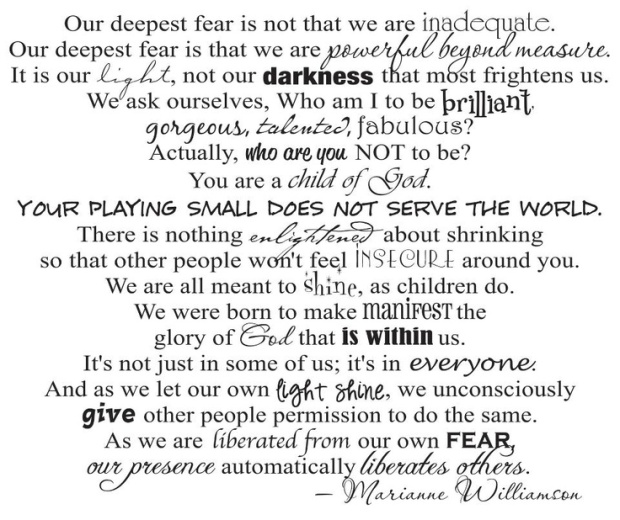
Our deepest fear

We all have stresses, strains and fears that are alive in our day-to-day journey. Some days these are more fuelled than others. Some days it is easier to shift back to peace, calm, joy, contentment than others. Some days it is easier to remember that all we have right now is now, the present moment, and that this is where we find peace, serendipity, motivation.

Where do I focus my attention? Does focusing my attention on what’s “not real” – the dreams for the future, the visions I am creating for myself – does this mean I am ignoring the condition of my life, the “reality” of my circumstances? If what we focus on is what we get, then focusing on a current reality that is full of fear, worry and stress about the future ~ because rarely is stress about this actual day ~ only means we will generate more fear, worry and stress. Which often leads to physical illness as well as the incapacity to move forward with little and big steps. Is this the future you want to live into?

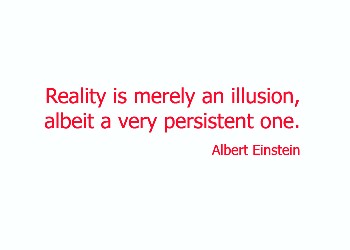
Einstein quote - reality - illusionAs I live in this place almost daily of discerning which is “illusion” and which is “reality”, I realize that, as human beings, most of us imagine the stress and strain of our physical condition to be “reality” and the dream of abundance, flow, financial security to be the “illusion”. It is a trick of the mind and when we fall for the trick of the mind, we lose touch with ourselves as powerful beyond measure and as an infinite being living a human experience – which is why this post starts with Marianne Williamson’s quote – to remind us it is our light we fear but that letting that light shine frees us and liberates others.

My visioning these days (even as my passive-aggressive relationship with the Law of Attraction continues) has been around remembering I am an infinite being and, as Abraham says, it is just as easy to manifest a castle as a button, just as easy to manifest $100,000 as $10,000 as $1,000.

We get caught in thinking we need to know the how – which is where stress and fear manifest. As Mike Dooley of The Universe Talks (TUT) says, we do not need to know the how – we just need to keep fuelling the vision and taking steps in that direction – even small steps – to help the Universe know we are serious and committed to the vision and allow the Universe to move mountains for us.

All of this can be hard to remember when you wake up in the middle of the night wondering where the next dollar, the next client, the next whatever is coming from. When you worry about your health or the health of someone dear to you. When you wonder about your relationships. When your insecurities loom larger than your hopes.

It is not irresponsible to dream. It is irresponsible not to dream. It is responsible to aspire to be your best self, to keep moving in the direction of your dreams, to remember you are an infinite being and you are powerful beyond measure. Do not be lured into believing current circumstance is reality. This too will change. Believe in your dreams. Acknowledge the twists and turns along the way, but don’t get stuck in them, and embrace illusion as reality.

You Are Worthy

Slide1

You are worthy and you are worthy of your gifts and talents. Do not let anyone convince you otherwise – including, especially, you.

It does not matter that you are not, thankfully, perfect. It does not matter that you have made “bad” choices in your life or choices you regret? It does not matter that you may have, at times, acted inauthentically, out of integrity or even immorally. It does not matter that it has taken you your whole lifetime until now – or later even – to step into your gifts. Have you been keeping track of how often you have paid the price – over and over again – for one of those “mistakes”? Your debt, if there was one, is paid. With an abundance of interest.

You are worthy. You are worthy of your gifts and talents. They are inherently yours to accept or deny. Although you may find they will not be denied.

When the time is right, when you are ready, in the moment of epiphany that brings on that quiet knowing, you will find the courage to step in, to step in fully, to claim the gifts that are your own.

Are you willing to put them on, embody them, own them, instead of wondering when someone is either going to take them away from you or give you permission to do what is only yours to do? Give yourself permission. Only you can do it. You are worthy of your gifts and talents.

You are worthy, even if you are afraid. The purpose of fear is to keep you safe? From what, you wonder? From abusing your gifts? You cannot abuse your gifts. You can only step in and allow things to flow through you. And they will. Because, you are worthy.

Let go of the self questioning, the self recrimination, the self judgment. It only gets in the way of the beauty and grace of who you are. You are worthy. Do not let anyone convince you otherwise. Especially you.

Palms holding a beet shaped like a heart

Facts, Stories, Courage, Justice, The Court System

I went to court once. It was a simple matter. I was contesting a $275 ticket I was given for illegally walking across the railroad tracks in Bedford, NS. Yup. Turns out that’s illegal. Who knew? The policeman, who reluctantly issued the ticket (which is different story), did tell me that I could contest it in court. So, I went to court. I watched all the cases called before mine. Citizens, representing themselves, showing up to contest tickets of various sorts – not wearing a seatbelt, not wearing a helmet while cycling, other ones that I don’t recall. What I do recall is that systematically every case was “won” by the court – which had a lawyer present, a process, witnesses (usually policemen) with notes. The contestants had none of these. I knew, that had my case gone forth, there was no way I was walking out of there a winner. Except, thankfully, the policeman who issued the ticket did not show up. My case was dismissed. I walked away with a glimpse into a system of law that is not necessarily a system of justice but a system of process.

Scales of JusticeI am reminded of this little incident by a very high profile celebrity sexual offence case taking place before a judge in Canada at this moment. A case which is not only re-traumatizing the accused’s victims but a host of other people – primarily women – who have experienced something similar in their lives. It makes me think of the system of law, which may or may not be the same as justice. A court system that wants to protect an accused as innocent until proven guilty, so much so that the victims are on trial as much as or more than the accused and seem to have to prove their innocence, and even purity, rather than have it assumed.

I am thinking about the women who have had the courage to pursue this case, or similar ones, in the courts, who are taking the stand, whose stories are being cross examined in the search to cast doubt on the facts of the testimony. Re-victimizing victims, as if it wasn’t hard enough the first time, or difficult enough to step forward. It is a system that does not encourage women, perhaps any victim, to step forward, because it treats them harshly.

It is supported by a societal wide phenomenon that immediately casts doubt on any woman’s story of sexual assault – casting doubt on the woman herself. Even when many women step forward about the same man, as is the case in this situation,  there is more doubt about their character than his, as if there is a conspiracy against him. “Why didn’t you go to the police?” they are asked. “Why didn’t you speak up sooner?” Over and over again the answer is that they did not think they would be believed. Which is exactly what happens.

The women in this case say that the accused was, in one moment, the epitome of charming and, in the next moment, he was hitting them in the head or choking them in a rage. There is consistency across the stories, the ones in the courtroom, the ones reported in the media, the general knowledge that existed in the milieus of social settings the accused and the victims found themselves in. Part of the challenge to the credibility of the women is that, in this case, they often describe an initial encounter and then a subsequent encounter. Why did they engage the subsequent encounter if the first went so badly, is the obvious question? Surely it couldn’t have been that bad? Surely now you are only seeking revenge?

In reflecting on this and some of my own experiences (not nearly so extreme) in life, it occurs to me there is a gap created by cognitive dissonance – a gap in stimulus and response. A public figure. Charming to the extreme. Seeking some of these women out. Surely the rage is a momentary lapse, not the essence of this person? The mind is resorting to logic to try to make sense of what just happened. The beating, the rage, is “out of character” with what is known or presumed known about this individual and these women found themselves back in his vicinity, imagining a better situation, imagining a respectful encounter. Surely you have encountered such a cognitive dissonance – where it takes your brain awhile to catch up to what your experience is telling you to be true? I know I have been.

And then there is the role of facts. The court system is interested in the facts and in evidence. Part of the issue in testifying is that we relay our experiences through stories, stories that are a mix of facts, emotions and values. And there is research that disputes the idea that factual memory is accurate. If you have ever told a story and had someone contradict the “facts” you relayed with their own, you know how difficult it is to agree on the “facts”, because people remember different things. Was it this or was it that? Who knows for sure?

It is easy to get stories confused for several additional reasons. Stories are how we make meaning of our experiences. And we rarely ever tell the same story twice in exactly the same way. As time goes by, how we relate to the story and the experience may shift and change, as we try to imagine it never happened, or as we heal, as we move on, as we learn from our experiences, as we gain distance from the event. The story you tell now about something you experience today may be very different a month from now, a year from now, a decade from now. Yet in a trial, the person on the stand is expected to tell the exact same story, without variance, from the time they gave their statement to the time of the trial and, at a minimum, months, if not years have gone by. Any contradictions become “proof” of their inconsistency and unreliability as a witness.

When I was writing Embracing the Stranger in Me: A Journey to Openheartedness, a memoire spanning several decades, I came across my own writing from a decade before – writing done very close to the experiences I was describing. How I remembered those situations and the rawness of the writing immediately following the experiences was very different than how I recalled them a decade later.

courtroomI find my heart breaking for these women on the stand and for the many more who refused to go there because there is too much trauma, too much shame, too much self doubt and self recrimination. I am torn by believing people do have a right to a fair trial and wondering if that should not also apply to the courageous people who step forward to testify. And I continue to wonder if our justice system delivers justice while understanding the need and increasing demand for processes like restorative justice.

And mostly my heart aches for a society that will dismiss the voice of a woman to such a degree that even in numbers there is doubt. My heart aches for a society where people are ostracized for pointing out what is common knowledge in a community, an organization or a social system. I wonder how we have come to be such great protectors of the shadow side, the underbelly, and so afraid of the light. I yearn for places and opportunities for people to be supported and celebrated for doing the right thing, for stepping forward, for making us all safer. And, I hold space from my little corner of the world, for each person who speaks a truth known to many openly and courageously. May we be these people.

We Are All A Bit “Broken”

Not a single one of us makes it through childhood without being “broken” ~ at least a little bit and maybe a lot. It begins without our conscious awareness but with our complicity. Why do I say this? Because our very survival depends on it.

We might not survive childhood if we did not find ways to fit in, to be good, to make others (usually our parents or other caregivers) happy. For some children this is literally about survival; for many, it is more figurative but still impactful. We shape our lives and ourselves to do just this ~ to fit in, to survive. It is the conditioning of the experiences, the worldviews, we are born into and that we adapt to and adopt. Our behaviour and attitude adjust to the conditions we find ourselves in.

An unintended consequence of this, for many of us, is that adapting to conditions disconnects us from ourselves, from aspects of who we are at the core, our soul essence. I write about this extensively in Embracing the Stranger in Me: A Journey to Openheartedness. Elements of this stranger are the soul qualities and gifts we come into the world with, that we are intimately connected to when we are born, before we learn concepts of right and wrong, good and evil.

cropped-official-book-photo.jpgAs we move from infancy to toddlerhood, we learn it is not always, maybe usually, safe to expose our inner being. When it shows up in innocent ways, the openness, genuineness and authenticity of it, it can be perceived as a threat to others who have carefully cordoned off their own soul essence ~ also to survive and without knowing  or discovering any better ways. Our own soul essence begins to feel fragile rather than strong. Beyond words, our protective instincts kick in and we create protective patterns (excerpted from Embracing the Stranger in Me: A Journey to Openheartedness; pp 12 and 13).

These protective patterns are perpetuated throughout much of our life’s journey. They influence our relationships and our communication, again, usually in unintended ways ~ because why would we intentionally live out many of the patterns we do, patterns that are hurtful and harmful to ourselves and to others? Along the way, bit by bit, we become more broken – to greater or lesser degrees, depending on the circumstances of our life, the people in it and the patterns of brokenness amplified, projected, mirrored in relationship.

broken - a little bitAnd yet, broken crayons still colour. And so do we. We may choose stark colours to sketch the lines of our lives or we may choose the vibrancy of the full array of colours. Depending on where we are in our journey at any given time, we may choose different crayons, different contrasts. We begin to reclaim our light and our wholeness when we remember we have choice, that our own brokenness can invite us into compassion – for our own journey and for others. It can invite us into the fullness of our humanity. So beautifully expressed in the lyrics of Anthem by Leonard Cohen:

Ring the bells that still can ring
Forget your perfect offering
There is a crack in everything
That’s how the light gets in
~ Leonard Cohen ~

Gold repaired bowlIt is like the Japanese art of Kintsugi ~ repairing broken pottery with gold, to not hide our brokenness but celebrate it because it is how the light not only gets in, but also shines out. Because of our brokenness we can enjoy a depth of experience not otherwise available to us. We can gain a deep appreciation of love and what it means to love despite everything. Embracing our brokenness enables us to embrace our wholeness. They are not mutually exclusive and this is the journey to openheartedness.

Dementia and Alzheimers: A Fate Worse Than Death?


Despite the prevalence of dementia and Alzheimer’s in the population and the increasing odds we will, at a minimum, come into contact, if not already in relationship, with someone who has this condition, many people are at a loss as to how to deal with, communicate or connect with someone who is losing their memories and, in the eyes of many, their very identity. It pains us to be in the same space when that person does not remember us. And this is exactly the problem – if you make it about your pain and not about the person who is still there, who still needs and yearns for friends, connection and companionship even if they no longer no how to express it, who still yearn for acceptance and love even if they do not have the words.

Why is it so difficult? How often do you hear, or even use, the phrase “I came face to face with my own mortality”? When someone close passes? When a certain age is reached? When you’ve had a close encounter with death – real or perceived? That’s hard enough, but what if you perceive dementia to be a fate worse than death? You see yourself in that person’s shoes and don’t like what you see or can imagine, don’t want to live that way, don’t think it is a life. And you become dumbfounded and wordless because you are no longer interacting with the person in front of you, you have closed in on yourself and are dealing with your own life journey and life fears.

My mother’s journey with dementia and in long-term care illuminated and tested some of my own fears and spiritual beliefs. Did I really believe the things I said I did? Did I really believe consciousness is not fixed but that it expands and travels? Did I really believe we are souls living a human existence? Did I really believe there is a fine line, just a veil really, between the physical and the non-physical? Or did I believe, as I often did, that the hallways I walked to visit my mother were the corridors of death and the dying? In Embracing the Stranger in Me: A Journey to Openheartedness I have included stories of the impact of my mother’s journey on me, as well as in many blog posts over the years.

My mother, in a time of her life when she could no longer string coherent sentences together – in fact, could no longer even find her words – showed me the way into depth of understanding. It is because of her that I began to think of two ways of experiencing stories – through the human tragedy lens or the soul journey lens. The human tragedy lens is one through which the physical journey here on earth does not make sense – because of things like dementia or other illnesses or any other range of possible things that pain us or cause us grief. The soul journey lens is the one through which peace can be found. It is expansive and offers a myriad of possibilities. It is the one that says I cannot measure my mother’s (or anyone else’s for that matter) experience by the lens of my own story.

What to do or say to the person who is living with dementia? It is simple really.

  1. Set aside your expectation. Do not expect them to be the spouse, parent, sibling, friend that you remember and maybe even romanticize. They are not that person now. But they are sill a person. Meet them in their humanity – the humanity you see when you look in their eyes (yes, look into their eyes!)and  see into the soul.
  2. Don’t let your own discomfort get in the way – or, in other words, get out of your own way..
  3. Set aside your own fear and your story of their situation.
  4. Greet them warmly – the way you used to – like the friend or loved one that they are. Because that is the essence of who they still are. They will be relieved.
  5. Don’t let it matter that they don’t remember who you are and don’t ask them if they do. In fact, don’t ask them any question they won’t be able to answer.
  6. Answer the same question 100 times in 10 minutes as if it was the first time it was asked, without exasperation, frustration or sadness.
  7. Tell them what’s up in your life without feeling guilty that you still have one when you perceive that either they don’t or you understand how much narrower their life is now than it used to be.
  8. Remember humour. We all like a good laugh. And it is okay to laugh with them.
  9. Stay tuned to where they are – it can change from day to day and it can change rapidly in the progression of the disease. Meet them where they are.
  10. Bring love. Lots and lots of love.

I am deeply touched by this video by Mary Beth Beamer of husband Alan and their appeal for friends to keep visiting. I appreciate the #Stillhere campaign by the Alzheimer’s Society. One of the things I deeply appreciated about the staff at Harbourview Haven where my mother stayed was that up to the very end they treated her with tenderness and care and like the whole person she still was even if her cognitive ability was pretty much gone because she was #StillHere.

Who do you know that has dementia or Alzheimer’s? When was the last time you visited with them? Go now. Or soon and remember the advice in this little gem too.

Alzheimers-Dementia-Communication Advice

Tis the Season of Joy — and Sorrow

The holiday season is an amplifier.  It is often a time of great celebration and joy as family members and friends gather together in gift giving and meal sharing.  It is also a time of great sorrow for many as reconstituted families find new patterns of gathering and as many of us feel the absence of loved ones who are elsewhere, may have departed, are sick or dying or in long term care facilities or simply no longer a part of our lives.  And it can be overwhelming and stressful as we strive for perfection in a season that often already demands a lot of us and where expectations run high – the ones we have of ourselves and of others.

It is impossible to live life and not have our fair share of  joy, sadness and stress.  Simple little delights often bring the joy.  A particular Christmas song.  Lights.  Tree trimming. Christmas celebrations.  Buying someone that perfect little something – or creating it.  Traditions that are meaningful.  Conversations that are as delicious as the traditional holiday fixings.  Lovely memories.

joy at Christmas

The things that make the heart sing are a beautiful thing.  The things that make the spirit sad are harder to acknowledge.  Absences seem to be one of the most significant contributors to sadness at this particular time of year.  The absence of loved ones.  It is an experience I know.  We all do.

unhappy puppy in Christmas Hat

One example in my life: my mother is in long term care with dementia.  She’s been there now for three and a half years. Since May, seven months ago, we have been told she could leave us any day.  Some small part of her still inhabits her physical body while most of her is having a different kind of experience that is beyond my knowing at the moment.

She has been absent from our family Christmas celebrations the last two years physically and to varying degrees cognitively for longer than that.  A week or so ago, I was in a shopping mall.  Something in a store caught my eye. I was hit with a wave of missing my mother – really for the first time.  This woman loved Christmas and loved opening presents so much it happened so fast it was over almost before it began – until we found ways to slow the process down.  My mom was always like a kid at Christmas when it came to presents – until she forgot what to do with a present, forgot what it was or even how to open it.

We all have these kinds of stories.

Some of us have stories of being in relationships that are not fulfilling, meaningful or relevant anymore.  Some of us are no longer in relationships and carry sadness or regret as a result. Some of us are in relationships with loved ones who live far away from us.  This is a season that brings nostalgia about better times and brings heightened awareness of what is not working.  It shines a light on the imperfections of our lives and relationships.  It brings loneliness even as we are surrounded by people and festivities.

In a season that is “supposed” to be joyful, we don’t always know how to handle the emotions and times that are not.  When we try to suppress them, we just drive them underground for awhile.  They will resurface when an opening shows.  There is nothing wrong with surrendering into our sadness long enough to acknowledge it.  If it continues to overwhelm us deeply maybe we will need help to come out of it, but for most of us, surrendering into and acknowledging our own emotional turmoil, allows release.

There is nothing wrong with tears.  Truly, there isn’t.  Although many of us believe there is.  We apologize for our tears.  Like we are somehow weak and maybe imperfect because we cry – especially when we cry in front of other people.  But tears are releasing and healing and an indicator of our experience.  How much more beautiful it could be if we stopped apologizing for tears and let ourselves be in our experience and even have it witnessed by other people.  In the event it makes others uncomfortable, other people’s uncomfortablenss with our tears is not our responsibility.  And for most people who witness, it is also freeing for them.

As we allow ourselves to move through our own experience, we create more space for joy and delight to show up faster in our experience.  Staying in our sadness will not fill the absences, will not bring back people no longer here or bring people to us who are far away.  And most of those absent, would not want us to be lost in our sadness but would want us to celebrate the joy and vibrancy of life.  Even if they wouldn’t, our soul is inviting us to celebrate the vibrancy of life.

Another thing that detracts from the vibrancy of life is the stress of trying to make the perfect holiday – on top of so many other things that need tending – children, parents, work, life and death.  Very little of this stops just because it also happens to be Christmas and we now also need to shop, bake, decorate, wrap gifts, go to Christmas concerts and Christmas parties.

Some things could be left undone or done a little short of perfection.  How many cookies do you really need to bake?  How many presents do you really need to buy?  What if you boiled it down to the one or two essential elements that seem the most dear to you?  For me, it is gingerbread houses.  I make the house parts.  I thought about buying them one Christmas but realized how much a part of me is in this tradition – because I love to bake and love the delight of the gingerbread house process from start to finish.  Most of the rest of it I can let go – especially in my experience of reconstituted families.  When and how things happen is a matter for conversation and joint decision making that usually extends beyond my immediate family.

Tis the season of amplification.  What is joyful is more so, what is sad is more so, what is stressful is more so.  Tis also the season of reflection and remembering.  And maybe most important of all, let it be the season of self-care – because, in that, we shift and grow our capacity to embrace the joy, delight and imperfections of being human that are completely available to us in the season of amplification.

(Originally published in 2011 at Shape Shift Strategies.)

The Passing of an Era

It was the end of January 2008. I was driving down the highway on my way from Halifax to Yarmouth, Nova Scotia on a beautiful sunny winter’s day. I wasn’t just on a road trip for the day, I was on a journey to another era – a past I knew very little about, to visit a man I knew very little about. I was on my way to meet Fred Hanson. A few brief weeks before this I had found out he existed, that he was my birth father, that I had a birth family of which I had had no conscious awareness. Yet he – and the whole family – knew about me for all of my life.

On Wednesday, October 21, 2015, Fred died with his wife Doris, her son Corey and my sister Debbie van Soest present, bringing to a close another chapter of my own life, the passing of an era.

Kathy (2 years old) and Deb (5 years old) visiting in 1964 at Nanny and Grampy Hanson's house in Digby

Kathy (2 years old) and Deb (5 years old) visiting in 1964 at Nanny and Grampy Hanson’s house in Digby

I did not know Fred well. Most of his life had been lived by the time I met him. There are three things that stand out. When he, at the age of twenty-three, and his little family – me as an infant and my sister as a three year old – were abandoned by my birth mother, he did what he could to make sure we were looked after. This meant uprooting us from Halifax to Digby NS where he had grown up and where his parents still lived. Because my grandmother was already ill with brain cancer and my grandfather was already well on his way to alcoholism, they searched for help. Help arrived in the form of my parents, Mary and Hector Jourdain, married a few years, living in Digby at the time and still childless. An agreement was reached for my parents to adopt me and for me to know my birth family. Which I did until my grandmother died when I was still very young. Fred knew where I was and for all the years my adoption was a secret (from me and my brother at any rate), he kept his word and he did not seek me out.

Fred and Kathy

Me and Fred – March 2008

The second thing that stands out is how nervous he was to meet and how welcoming when I walked in the door. He’d been pacing from the front window to the kitchen window to the door in anticipation of my arrival. The door was opened before I even had a chance to get out of the car. He hugged me and we found our way through the awkwardness of first meeting. He gave me pictures from when I was baby.

The third thing that stands out was his agreeing to let me interview him for my memoir: Embracing the Stranger in Me: A Journey to Openheartedness. As I asked him questions and took him back through memories he had not thought of for decades, he forgot for a moment that I was interviewing him. He reflected on the moment my birth mother left and his incomprehension, still all these years later, that she could leave two babies behind.

Doris and Fred 2006

Doris and Fred Hanson, 2006

Fred had a sociable side that enabled him to fit in many places – like the Red Knight in Yarmouth where he and Doris often when for a beer and to hang out with friends. And he had a sarcastic wit that made him a great sparring partner. I didn’t know his second wife who raised my sister Debbie and brought my half sister Robyn into the world. I did however have a chance to meet Doris and experience the warmth and hospitality of their beautiful home. They were together for 28 years.

I am blessed to have known him, filling in some blanks of life story for both him and me. There are many stories that will not be known and many that will not be written now. I do know his brother Bill, his parents and others greeted him as he passed over. My mother and my birth mother had a pact together with Fred and my dad that has gifted me with multiple lineages that are important and relevant to my own life journey and in many ways I am only at the beginning of that exploration. And for now, it is grieving and celebrating the passing of an era.

The Voice of Your Inner Judge

There is no more powerful limiting mechanism in our lives than the voice of the judge.  I don’t mean that other person – parent, spouse, child, teacher, boss, friend, co-worker, random stranger on the street or in the shopping mall.  It’s the internal voice of judgment or internal critic that often runs rampant inside of us that we barely notice, if at all, because it is so clever and really good at disguising itself – for self preservation really.

I first became intimately acquainted with my inner judge in 2008-09 during coaching work with Sarita Chawla.  She recommended I read Soul Without Shame by Byron Brown in addition to the work we were doing together. I will forever recognize this as a pivotal point in the shifting shape of my openhearted journey.  I wrote about the voice of the judge back then in an article.  I am reviving that article here now in an updated version .  When I first wrote this post, my inner critic was activated – obvious to me because of how I felt – and I am reminding myself of strategies I already know that help to deactivate it and release its grip on me.

When I first became aware of the force of the internal judge, I had been working with the concepts of self-leadership and hosting oneself for almost as long as I could remember – still do, of course.  I worked with coaches, read books, did courses, took part in and led deep group work.  I am generally a positive, optimistic person holding deep appreciation and gratitude for much of what transpires in my life and who shows up.  I have transformed the negative self talk of my “itty-bitty-shitty committee” into more appreciative forms of self talk and into periods of quiet in my mind.  I meditate and practice other forms of reflection and mindfulness.

So, imagine my surprise when I discovered a voice of self judgment and self criticism that was booming loud and clear in my unconsciousness, stronger than any external voice of judgment or criticism could possibly be.  This voice constantly set the bar for my performance at the best that I had ever achieved.  The bar moved if I did better.  When I didn’t match my most excellent performance, even when I did extremely good work, this voice told me that I had failed, that I did not measure up and that I never would on a consistent basis.  Strong performance was interpreted as mediocre.  Criticisms from others, whether justified or not, was reinforced by this inner critic.

When I felt most down on myself or just down in general, this voice played a significant role – and still can in moments I feel most overwhelmed or vulnerable – until I expose it.  I didn’t actually hear it as a voice until I began to listen for it but I felt it strongly in many forms: sadness, unhappiness, melancholy, anger, listlessness, lack of motivation and many other emotional manifestations.

While I had been aware of this voice (or at least the emotions it manifested in) to some extent, I also prided myself on my journey of self-transformation and change.  Been there, got that medal, surely I must be done now, can I just get on with my life and success?  I realize now it was the voice of self judgment that said, “You’ve been doing this long enough, how come you’re not done?”

Part of the reason I had been pretty oblivious to this voice was because, in my quest to be calm Happy-sad masksand serene and professional, I skirted over my own emotional reactions.  I barely recognized I had them except in the odd instances where they overtook me.  Oh, was that an emotion that wasn’t calm and serene?  Oops.  Nope. Couldn’t have been.  It must have been something else.

Then, a friend told me I deal with my emotions intellectually.  So, I thought about that.  And I thought my friend just might be right.  Emotions don’t reside in our intellect.  They reside in our bodies.  We feel them and sense them.  We use metaphors to describe them.  We say things like, “That packed a punch!”  If we stop to notice, we will notice where it feels like we got punched.  And if we stay with that, we will begin to notice the impact.  And if we stay with it longer, we will notice the uncomfortableness and want to move onto something else.  This is where I am learning to stop.  I have learned to stay with it longer, until I can begin to discern the wisdom that is held there and that can only emerge when we give it an escape hatch to surface to the light.

It is in these moments that my voice of self judgment has come booming out at me in all of its voraciousness.  With all good intentions, all it wants to do is protect me – from failure, from being unlovable.  But its methods only serve to reinforce for me my failures, even to the extent of turning successes into failures, thus creating in my mind my own unlovability and unwantability.

CA red dress Day 1I learned to journal in this voice.  I am astounded by the punch it does pack.  Periodically I sit and check inside of me to sense into what I’m experiencing and feeling and what the impact is.  I journal what I am sensing until I feel done.  Then I check in again to see what I am experiencing, sensing and feeling, and then journal again. And then again, if that seems required.  I am committed to going the next layer deep and the next until I feel the light flood back into my soul and I feel a lightness of spirit and of body. This is what I want to amplify in my life now.

Exposing my voice of self-judgment transmutes it into a gift of understanding and insight after which joy can once again arise and take more of the space that is its, and my own, rightful due.  Now, instead of seeing my journey as one that should be concluded and being hard on myself because it is not, I see my journey and myself with a gentleness I could not access before as it was hidden underneath the protective layer of the voice of judgment.  I have always known, intellectually, that learning and growth is a life long journey.  Now I know it and accept it with a graciousness that only comes from the light.

(This post was first published at Shape Shift Strategies on December 20, 2011)