Are you holding your sadness as a treasured possession?


5-of-cups-legacy-of-the-divine2Every now and then a question shows up that captures attention as if it was lit up in flashing lights. This happened to me the other morning as I pulled my usual three tarot cards from the Legacy of the Divine deck (my favourite) to help me imagine what the story of my day could be like. One of the cards I pulled was the 5 of cups. Not necessarily a favourite, I decided to open the interpretation book to see what jumped out at me.

Why do you sometimes cradle your sadness like treasured possessions? Are you afraid that the power of your heart will shatter it and force you to leave the safety of the shadowy misery you cling to?

Sadness as a treasured possession? Shadowy misery? Crap! And wham! Both at the same time.

A while ago I wrote about what is real and what is illusion. And I’ve written about my passive aggressive relationship with the law of attraction. And about limiting beliefs.

The journey of life has a way of dishing up illusion so we imagine we are in a different place than we are. It also has a way of waking us up to reality. Like these questions.

I feel the tremulousness of these moments in my life. Partner I love deeply who lives in another country. Re-imagining our work and our businesses. Feeling the pull of life, co-parenting, scheduling. Desiring ease and not always experiencing it. Am I cradling sadness as a treasured possession? Is it part of how I define my story? It is not what I want to hear, to believe is true in this moment but there it is right in front of me.

Am I clinging to shadowy misery? Am I allowing this to define and shape the story of my life in this present moment?

What to do about it?

  1. Allow the recognition of the response evoked by the questions. Yes, there is truth there. Still. After many years of journey.
  2. Invoke compassion for myself. It is a journey. It is not right or wrong or too long. No self-recrimination, just awareness.
  3. Journal to surface and release the patterns so deeply entrenched in my being that sometimes I fear they will never be fully released and most times now I can recognize as part of the unfolding journey – the journey to openheartedness.
  4. Meditate on the vibration I am aspiring to, to let it permeate my physical and soul essence to continue to attract my dreams.
  5. Take concrete steps, even if small, to show – myself, creator, the universe – that the dream I hold is the direction in which I am moving.

I share this because I know I am not the only one cradling sadness and clinging to shadowy misery. If this resonates, know you are not alone and follow the steps.

You Are Worthy

Slide1

You are worthy and you are worthy of your gifts and talents. Do not let anyone convince you otherwise – including, especially, you.

It does not matter that you are not, thankfully, perfect. It does not matter that you have made “bad” choices in your life or choices you regret? It does not matter that you may have, at times, acted inauthentically, out of integrity or even immorally. It does not matter that it has taken you your whole lifetime until now – or later even – to step into your gifts. Have you been keeping track of how often you have paid the price – over and over again – for one of those “mistakes”? Your debt, if there was one, is paid. With an abundance of interest.

You are worthy. You are worthy of your gifts and talents. They are inherently yours to accept or deny. Although you may find they will not be denied.

When the time is right, when you are ready, in the moment of epiphany that brings on that quiet knowing, you will find the courage to step in, to step in fully, to claim the gifts that are your own.

Are you willing to put them on, embody them, own them, instead of wondering when someone is either going to take them away from you or give you permission to do what is only yours to do? Give yourself permission. Only you can do it. You are worthy of your gifts and talents.

You are worthy, even if you are afraid. The purpose of fear is to keep you safe? From what, you wonder? From abusing your gifts? You cannot abuse your gifts. You can only step in and allow things to flow through you. And they will. Because, you are worthy.

Let go of the self questioning, the self recrimination, the self judgment. It only gets in the way of the beauty and grace of who you are. You are worthy. Do not let anyone convince you otherwise. Especially you.

Palms holding a beet shaped like a heart

Facts, Stories, Courage, Justice, The Court System

I went to court once. It was a simple matter. I was contesting a $275 ticket I was given for illegally walking across the railroad tracks in Bedford, NS. Yup. Turns out that’s illegal. Who knew? The policeman, who reluctantly issued the ticket (which is different story), did tell me that I could contest it in court. So, I went to court. I watched all the cases called before mine. Citizens, representing themselves, showing up to contest tickets of various sorts – not wearing a seatbelt, not wearing a helmet while cycling, other ones that I don’t recall. What I do recall is that systematically every case was “won” by the court – which had a lawyer present, a process, witnesses (usually policemen) with notes. The contestants had none of these. I knew, that had my case gone forth, there was no way I was walking out of there a winner. Except, thankfully, the policeman who issued the ticket did not show up. My case was dismissed. I walked away with a glimpse into a system of law that is not necessarily a system of justice but a system of process.

Scales of JusticeI am reminded of this little incident by a very high profile celebrity sexual offence case taking place before a judge in Canada at this moment. A case which is not only re-traumatizing the accused’s victims but a host of other people – primarily women – who have experienced something similar in their lives. It makes me think of the system of law, which may or may not be the same as justice. A court system that wants to protect an accused as innocent until proven guilty, so much so that the victims are on trial as much as or more than the accused and seem to have to prove their innocence, and even purity, rather than have it assumed.

I am thinking about the women who have had the courage to pursue this case, or similar ones, in the courts, who are taking the stand, whose stories are being cross examined in the search to cast doubt on the facts of the testimony. Re-victimizing victims, as if it wasn’t hard enough the first time, or difficult enough to step forward. It is a system that does not encourage women, perhaps any victim, to step forward, because it treats them harshly.

It is supported by a societal wide phenomenon that immediately casts doubt on any woman’s story of sexual assault – casting doubt on the woman herself. Even when many women step forward about the same man, as is the case in this situation,  there is more doubt about their character than his, as if there is a conspiracy against him. “Why didn’t you go to the police?” they are asked. “Why didn’t you speak up sooner?” Over and over again the answer is that they did not think they would be believed. Which is exactly what happens.

The women in this case say that the accused was, in one moment, the epitome of charming and, in the next moment, he was hitting them in the head or choking them in a rage. There is consistency across the stories, the ones in the courtroom, the ones reported in the media, the general knowledge that existed in the milieus of social settings the accused and the victims found themselves in. Part of the challenge to the credibility of the women is that, in this case, they often describe an initial encounter and then a subsequent encounter. Why did they engage the subsequent encounter if the first went so badly, is the obvious question? Surely it couldn’t have been that bad? Surely now you are only seeking revenge?

In reflecting on this and some of my own experiences (not nearly so extreme) in life, it occurs to me there is a gap created by cognitive dissonance – a gap in stimulus and response. A public figure. Charming to the extreme. Seeking some of these women out. Surely the rage is a momentary lapse, not the essence of this person? The mind is resorting to logic to try to make sense of what just happened. The beating, the rage, is “out of character” with what is known or presumed known about this individual and these women found themselves back in his vicinity, imagining a better situation, imagining a respectful encounter. Surely you have encountered such a cognitive dissonance – where it takes your brain awhile to catch up to what your experience is telling you to be true? I know I have been.

And then there is the role of facts. The court system is interested in the facts and in evidence. Part of the issue in testifying is that we relay our experiences through stories, stories that are a mix of facts, emotions and values. And there is research that disputes the idea that factual memory is accurate. If you have ever told a story and had someone contradict the “facts” you relayed with their own, you know how difficult it is to agree on the “facts”, because people remember different things. Was it this or was it that? Who knows for sure?

It is easy to get stories confused for several additional reasons. Stories are how we make meaning of our experiences. And we rarely ever tell the same story twice in exactly the same way. As time goes by, how we relate to the story and the experience may shift and change, as we try to imagine it never happened, or as we heal, as we move on, as we learn from our experiences, as we gain distance from the event. The story you tell now about something you experience today may be very different a month from now, a year from now, a decade from now. Yet in a trial, the person on the stand is expected to tell the exact same story, without variance, from the time they gave their statement to the time of the trial and, at a minimum, months, if not years have gone by. Any contradictions become “proof” of their inconsistency and unreliability as a witness.

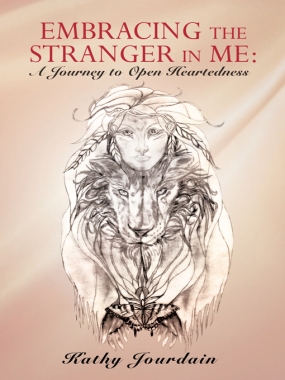
When I was writing Embracing the Stranger in Me: A Journey to Openheartedness, a memoire spanning several decades, I came across my own writing from a decade before – writing done very close to the experiences I was describing. How I remembered those situations and the rawness of the writing immediately following the experiences was very different than how I recalled them a decade later.

courtroomI find my heart breaking for these women on the stand and for the many more who refused to go there because there is too much trauma, too much shame, too much self doubt and self recrimination. I am torn by believing people do have a right to a fair trial and wondering if that should not also apply to the courageous people who step forward to testify. And I continue to wonder if our justice system delivers justice while understanding the need and increasing demand for processes like restorative justice.

And mostly my heart aches for a society that will dismiss the voice of a woman to such a degree that even in numbers there is doubt. My heart aches for a society where people are ostracized for pointing out what is common knowledge in a community, an organization or a social system. I wonder how we have come to be such great protectors of the shadow side, the underbelly, and so afraid of the light. I yearn for places and opportunities for people to be supported and celebrated for doing the right thing, for stepping forward, for making us all safer. And, I hold space from my little corner of the world, for each person who speaks a truth known to many openly and courageously. May we be these people.
The Passing of an Era

It was the end of January 2008. I was driving down the highway on my way from Halifax to Yarmouth, Nova Scotia on a beautiful sunny winter’s day. I wasn’t just on a road trip for the day, I was on a journey to another era – a past I knew very little about, to visit a man I knew very little about. I was on my way to meet Fred Hanson. A few brief weeks before this I had found out he existed, that he was my birth father, that I had a birth family of which I had had no conscious awareness. Yet he – and the whole family – knew about me for all of my life.

On Wednesday, October 21, 2015, Fred died with his wife Doris, her son Corey and my sister Debbie van Soest present, bringing to a close another chapter of my own life, the passing of an era.

Kathy (2 years old) and Deb (5 years old) visiting in 1964 at Nanny and Grampy Hanson's house in Digby

Kathy (2 years old) and Deb (5 years old) visiting in 1964 at Nanny and Grampy Hanson’s house in Digby

I did not know Fred well. Most of his life had been lived by the time I met him. There are three things that stand out. When he, at the age of twenty-three, and his little family – me as an infant and my sister as a three year old – were abandoned by my birth mother, he did what he could to make sure we were looked after. This meant uprooting us from Halifax to Digby NS where he had grown up and where his parents still lived. Because my grandmother was already ill with brain cancer and my grandfather was already well on his way to alcoholism, they searched for help. Help arrived in the form of my parents, Mary and Hector Jourdain, married a few years, living in Digby at the time and still childless. An agreement was reached for my parents to adopt me and for me to know my birth family. Which I did until my grandmother died when I was still very young. Fred knew where I was and for all the years my adoption was a secret (from me and my brother at any rate), he kept his word and he did not seek me out.

Fred and Kathy

Me and Fred – March 2008

The second thing that stands out is how nervous he was to meet and how welcoming when I walked in the door. He’d been pacing from the front window to the kitchen window to the door in anticipation of my arrival. The door was opened before I even had a chance to get out of the car. He hugged me and we found our way through the awkwardness of first meeting. He gave me pictures from when I was baby.

The third thing that stands out was his agreeing to let me interview him for my memoir: Embracing the Stranger in Me: A Journey to Openheartedness. As I asked him questions and took him back through memories he had not thought of for decades, he forgot for a moment that I was interviewing him. He reflected on the moment my birth mother left and his incomprehension, still all these years later, that she could leave two babies behind.

Doris and Fred 2006

Doris and Fred Hanson, 2006

Fred had a sociable side that enabled him to fit in many places – like the Red Knight in Yarmouth where he and Doris often when for a beer and to hang out with friends. And he had a sarcastic wit that made him a great sparring partner. I didn’t know his second wife who raised my sister Debbie and brought my half sister Robyn into the world. I did however have a chance to meet Doris and experience the warmth and hospitality of their beautiful home. They were together for 28 years.

I am blessed to have known him, filling in some blanks of life story for both him and me. There are many stories that will not be known and many that will not be written now. I do know his brother Bill, his parents and others greeted him as he passed over. My mother and my birth mother had a pact together with Fred and my dad that has gifted me with multiple lineages that are important and relevant to my own life journey and in many ways I am only at the beginning of that exploration. And for now, it is grieving and celebrating the passing of an era.

Human Tragedy Story Often Obscures Soul Journey Perspective

For a long time, I have believed we are soul journeyers having a human experience. The beauty and challenge of life is that our assumptions and beliefs get tested along the way.  In 2012, for me, one way has been through my mother’s journey.

adimirkush_Butterly

Painting by Adimir Kush

When the symptoms of my mother’s dementia were becoming more obvious in the years before she went into long term care, I knew it as a soul journey and experienced it as a human tragedy story.  This became more pronounced when she went into long term care.  Instead of being the only person in a household living out a bizarre new set of behaviours,  losing her capacity to communicate and do simple things like change the channel on the TV, she became one of many old and dying people no longer able to care for themselves, most living in their own little diminishing physical worlds.

The human tragedy story is amplified in these circumstances and places.  It is hard to see past the story of tragedy when it stares you in the face as you walk down hallways that evoke very visceral reactions in what you see, smell, hear or otherwise encounter – even in a place as loving and caring as the place my mother experienced as home in the last four years of her life.

CorridorHow many people came up to me, my brother or my father after mom’s funeral to share amazing stories about her that captured the essence of who she was and then proceeded to talk about how they just couldn’t visit her at Harbourview Haven.  How hard it was if she didn’t seem to recognize them.  How hard it is to be in that building when, as a culture, we have become disconnected from the death chapter of the life cycle.  We no longer experience it as part of the natural flow of life but as something to be feared.  Walking in a place where death is imminent generates fear and discomfort for many of us.  It did for me when I first began visiting my mother but, through my mother, the shape of my experience shifted.

For the few who were able to manage a visit or two, they expressed how amazing it was when there was a flicker of recognition in something she said.  I learned how many people besides me she called “little one” (really mom?!) and that was a point of reference for them.

There are others who saw enough through the human tragedy story to visit often.  My mother had a few of those regular visitors although we often didn’t even know it since she couldn’t remember who visited or when they did.  Deeply grateful for those dear friends.

The length of mom’s journey with dementia and her stay in long term care, invited me more deeply into this paradox of understanding  the human tragedy dressing of soul journey.   The phrase “oh, that poor soul” makes me chuckle now.  We use that phrase to describe the human tragedy perspective.  It is the physical experience that appears poor, not the soul journey perspective if you believe, like I do, that we make some choices before we manifest into physical form about what it is we want to experience for our soul journey this time around.

As my mother become more disembodied, I embodied the soul journey perspective from a deeper, more encompassing place of understanding.  Towards the end, her human tragedy story didn’t register for me anymore, only the soul journey perspective.  This gave me a high degree of peace during her long transition process, allowing me to live my life fully even while being present to my mother’s journey and our family care around it.

For the gifted people who work at Harbour View Haven, it seems to me they also see past the human tragedy perspective, treating each individual with full dignity and respect.  Treating them as if they are, what we consider, fully functioning, fully present human beings.  It was a gift to observe this most keenly in my mother’s final hours. It made me wonder what would happen if  we all treated others all the time with this kind of dignity and respect – whether we thought they deserved it, whether we thought they were fully human or not.

Living simultaneously with my mother’s journey, my journey and the rest of life, I’ve been thinking about how to express this all so it does not fuel the human tragedy story. I now speak about “the many streams of life”.  We are all in many streams of life all at the same time. Stuff happens.  Stuff comes up.  There is a life giving invitation to be well in all of it, although a more typical response is to be stressed by all the things that come our way that we have to take care.

I’m leaning into this invitation to flow with the many streams of life as though that is what they are, rather than challenges.  Greater spaciousness beautifully shows up.

And then there are the lessons of embodiment that have been present for me in a big way already in and since 2012.  As I embody my experiences and my learning I understand more deeply my life’s events, my relationships and my soul’s calling.

I’m not saying the human tragedy story isn’t real.  But the soul journey perspective is also just as real although harder for many to see, obscured by the human tragedy story.  The soul journey perspective allows me to live into joy and delight and allows me to fall in loveover and over again in a way living into the human tragedy story does not.

For my mother, I continue to experience a dance of joy, delight and lightness as her spirit soarspixies_in_the_sky-1868 free from the human tragedy unfolding of her physical body.  She continues to be my teacher and my friend and very, very real in my human experience.

(Originally published at Shape Shift Strategies Inc. on March 1, 2012)

Death and Dying – Lessons I Learned From My Mother

Originally Posted on February 16, 2012 over at Shape Shift Strategies Inc.

Never having been present at a death before, I didn’t know what to expect; and, it wasn’t what I expected.  My brother, father and I held vigil, practically holding our collective breath, as my mother, Mary Patricia Ann Ritcey Jourdain, drew her last, peaceful breaths on Wednesday, February 8, 2012, falling quiet at 12:30 pm.

Then there was silence.  Her silence.  No more rattling breaths drawn with some effort through her lungs into her ravaged body; ravaged from dementia for many years and the refusal to eat for many months.

Our silence.  In reverence for my mother, her journey and the honour of witnessing the final stages of her transition from physical form into spirit.  I already believed much of her consciousness was active in the subtle realms even as her physical presence diminished.  With her last breaths I imagined her spirit gently tugging until the last wisps of it were finally released into a delightful little dance of joy and freedom.

My mother with the beauty of youth.

My mother with the beauty of youth.

My mother’s journey with dementia was a long one.  My journey through hers was an inspired one.  Her greatest teachings for me may have been in these last few years when she could no longer string coherent sentences together, during the contrast of those times when she seemed to have no awareness of my presence to when I knew she was aware I was there.

I had one of those moments of her awareness the night before she died.  We had moved her to a special room where I could stay with her overnight.  One of her medication times was missed.  I was aware of that but she didn’t seem to be in distress. So, I sat on the arm of the couch, eye level with my mom.  I looked into her blue eyes and she held my gaze.

Summer 2008 212

Me and my mom just after she went into long term care. We posted all kinds of family pictures on the wall behind her in hopes of, I’m not sure what.

When I say she held my gaze, I really mean she held my gaze.  She was just as present as I was.  In fact, I was mesmerized.  I couldn’t take my gaze away.

So, I talked to her.  I told her about some things in my life.  I told her how beautiful she is – not was, is.  I told her how gifted she is and how loved.  I thanked her for being in my life, for being my mom.  Mostly, I held her gaze with love.  Until she began to exhibit signs of distress and I went for the nurse.  And then she was gone again until the moment of her final breath.

Four of us still in the room but now the shape of our lives fundamentally shifted.  As long as we stayed sitting in the room, it was like she was still there in her emaciated form.  But, of course, now she was free of form.  Eventually we had to move and leave her next steps in the capable hands of the Harbourview Haven staff who would transfer her into the equally capable hands of the Dana L. Sweeny Funeral Home.

The staff at Harbourview Haven taught me about human dignity and respect through how they related to my mother.  Even up to the last moment, they treated my mother as if she was fully present and aware.  They called her by her name.  In the middle of the night they would come into our room.  “Mary,” they’d say, “We’re going to turn you over now.”  “Mary, we are going to give you your meds now.  It might sting a little.”

On the morning of her death, a care worker came in to wash her face and freshen her up, providing a depth of love and care, dignity and respect to a woman in her last moments on this physical plane.  I can’t say enough for Harbourview Haven and the care they provided, not just in those last few hours but in the three years and eight months (plus a few days) that my mother lived there.  And not just care for her.  Care for my dad too.  For our family.  They understand about death and dying.  That it is a process and a transition.

My nine year old (at the time) understands about death and dying.  Enough to ask to visit his grandmother with me when I told him I was going to see her.  He hadn’t been there much lately.  I told him what his grandmother looked like and how she was.  He still wanted to come, even when the call came to say it might be her last day.  And his older brother and his girlfriend came too.  We all sat vigil the day before she died, for hours.  Watching my mother with sidelong looks every time her breathing stopped – for the eternity that shows up in a moment.

I am now aware that dying and death requires the same kind of loving care and attention as birth does.  It is birth.  Birth back to spirit.

When my older boys were young children their grandfather on their father’s side died. Their dad and I had already separated.  They went to the funeral and afterwards I asked them how it was.  We began to talk about death.  They said to me, “We think it’s kind of like this.  You know when you go to sleep and dream and when you are in the middle of a dream it seems real?  But then you wake up and you know it was just a dream.  We think life is like that.  It’s really just a dream but it seems real.  Then you die, but really it’s like waking up and realizing it was just a dream.”  Such wisdom out of the mouths of babes.  Closer to source.

I wonder how my mother might be reflecting on the 79 year dream that was her life as Mary Patricia Ann Ritcey Jourdain this time around?

Emotions Are Your Guidance System

When on the openhearted life journey, we each have experiences that can take us to some deep places.  Depth invites exploration – if we want it to, of course. In a conversation awhile back,  a good friend who is near and dear to my heart asked me how I was.  In that moment, I said, “I’m discombobulated and my emotions are near the surface.”

“My emotions are near the surface.”  What an interesting turn of phrase.  What I meant was that sadness, sorrow, angst, tears were all near the surface and tears would spill easily and effortlessly with the slightest provocation – sorrow or joy.

I dug a little deeper to discover what was stirring in my soul that caused these emotions to be so near the surface.  In that exploration, I identified and released things that had been swirling around and in me about decisions and choices I have no idea if I will even need to make.  I began to settle into a place of not knowing and not needing to know in this moment, trusting clarity will arise in due course.  No need for decisions or choices today.

a moment of reflection

I surrendered back into peace, joy and delight as I had a little realization, an aha moment.  My emotions were near the surface again.  They were just different emotions than previously.  Which got me to wondering.  Do I even think of joy, delight, peace as emotions?  Seems I do.  But not in the same way as I think of sorrow, sadness, anger and grief as emotions.  Without being conscious of it, I’ve been making value judgments about my emotional experiences – just like I tell people we do in the coaching and teaching work I do.

Yup.  There I was, doing it too.  Sorrow, sadness, anger, frustration, anxiety – bad.  To have those emotions near the surface is bad.  Like they need to be contained.  We don’t really know what to do with them but many of us have learned that trying to contain them, while it might work in the short term, just doesn’t work in the longer term.

How many times people apologize for their tears, one on one, in circle, in some meeting or gathering, and how many times I say, “I look forward to the time we no longer feel the need to apologize for our tears.”  I have, for the most part, stopped apologizing for mine.  So it is always delicious to discover what all is still alive in me when I explore my own emotional state.

Today, when my emotions are near the surface, instead of a tear sliding down the side of my face, a smile might break out for no reason in particular, when I’m by myself, with my son, with my partner or directed at a stranger.

The strange thing is, just like we don’t necessarily know what to do with the emotions we judge as bad or negative, many of us also don’t know what to do with joy, love, peace, delight.  We can be pretty good if it’s episodic.  If there is a reason – like we have to have a reason.  We’re not so good at knowing what to do with prolonged bouts of happiness, joy or delight – but what a beautiful challenge to embrace.

If we are used to chaos and negativity in our lives, it just feels different to shift into a new normal – of peacefulness.  A new pattern.  A new way of being in the world. Shifting the shape of our experience. Quite delightful to cultivate actually.  And this state of being does grow on a person.  Thankfully.

What I’ve been learning in the course of my life’s journey is that our emotions – the full range of them – offer us guidance.  I used to think they made me weak – at least the ones I judged as bad.  I use to think being vulnerable was the opportunity for someone to attack me.  Now I know differently.  There is strength and power in vulnerability when it comes from authentic open hearted space.  And it takes courage to step into vulnerability.

My emotions are my guidance system.  They tell me how close or far away I am from my centre, from my soul essence. They are a clue to what I’m thinking, whether I am present or living in the past or future.  If I inquire into my emotional state I can find myself.  And I can change my state of well being by paying attention to my thoughts, discovering what I’m holding onto that doesn’t serve me.

I like finding myself in a place of peace and joy but it’s okay if I find myself somewhere else too.  My preference now, through the journey of life, is to find my way, continuously, through daily practice, back to a steady state of feeling good.

Expanding Awareness: A Few Suggestions For Growing Your Consciousness

IMG_2073

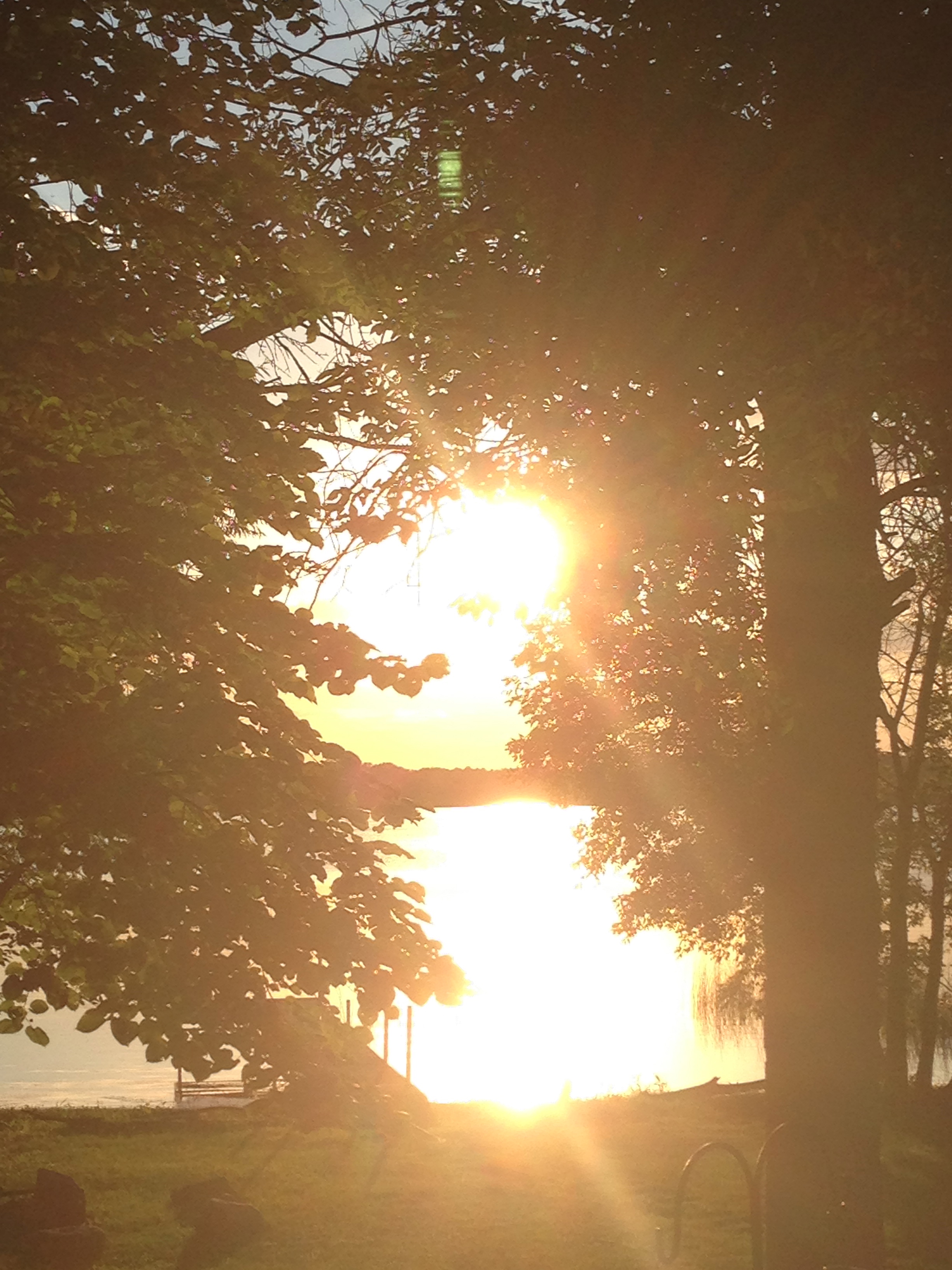
Lake Park, MN

Have you ever walked in the woods and felt yourself enveloped by the silence? Laid in the sun and lost awareness of everything around you except the warmth of the sun on your body? Or sat by the ocean and experienced the timelessness of the sand and waves, understanding your own life as a grain of sand on an ever changing beach? Or entered a cathedral and felt the history of the ages whisper in your soul? Have you encountered experiences and stories that raised every hair on the back of your neck?

All of this is information. All of this is expanded awareness, expanded consciousness. How do you go about intentionally expanding your awareness, growing your consciousness? Here are a few simple suggestions.

Pay attention to naturally occurring situations – any or all of the ones mentioned above and more – let your attention rest there and slowly expand your “gaze” to “see” or sense more. This is not necessarily seeing with your physical eyes, although it can be that too. This is seeing with your second sight, or your third eye, or your imagination – whatever you want to call it. Let a story unfold – or make one up. Your mind doesn’t know the difference between what is real and what is imagined. And when you know that your body is around 65% water, you begin to understand how much of what we think is real might actually be illusion.

Soften your gaze anytime, anywhere – including in your own living room, back yard, in a place with people – airports, malls. You can allow the energy that is in the space you are in float around you as if it has its own movement, its own story, its own being – because it does.

You can tap into your imagination, letting it run away in its own directions. Where does the inspiration for imagination come from anyway? Do we know it doesn’t come from some metaphysical influences?

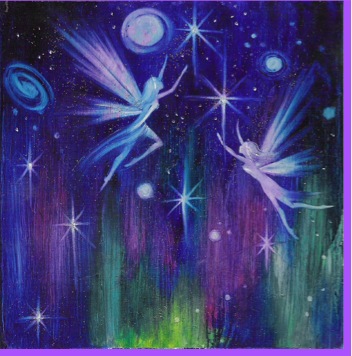
pixies_in_the_sky-1868When you are in the woods and you soften your gaze, can you see the wood nymphs, the faeries, the elves and other entities that wander there, that call it home? (If you are wondering if it is real or if you are making it up, see the previous post – it doesn’t matter.) If you could interact with them or talk to them, what would that interaction look like or sound like? Every time I expand my conscious to invite interaction with what I cannot see with my eyes but can sense with my being, the very first feeling is one of gratitude and appreciation for the acknowledgement. “Thank you for seeing me.” And very often there is light heartedness, joy and delight. A sense of playfulness. Hmmm, yes. Playfulness and light heartedness. True story.

It seems particularly important to see and acknowledge these beings / non-beings in city parks and green areas because so much more of the city’s energy is weighted down with concrete, asphalt and other man-made building materials. Every time these beings are seen and acknowledged it fuels them, gives them additional sparks of life.

Slide1

Beach photo courtesy of Peter Moorhouse

When you are on the beach, let your imagination wander into the water and see what comes into your awareness. The sea creatures – physical, non-physical, mythical. You can see them dancing on the waves, in drops of water, in the way the rays of the sun touch the surface and penetrate the depths.

In cathedrals built eons ago, feel the blood, sweat and tears of the men and women who built these structures. Feel awe at the feat as well as the grief and sorrow of those that lost their lives, the harshness of the times and circumstances. Imagine what it was like in the day they were built and what vision and perseverance it would take to bring it into being. And all the sacred ceremony that has filled the cavernous spaces inside, still alive in the density of the air.

notre dame paris cathedral

Notre Dame Cathedral in Paris

The ways to expand your awareness, expand your consciousness are not even limited to your imagination, although they are limited by doubt, by questioning, by not believing. Allow – no, invite – yourself to play, to dream, to imagine. And learn to trust your own experiences.

Is This Real or Am I Making It Up?

Harry_Dumbledore_limboOne of my favourite passages in the Harry Potter books is when Harry is in the in-between space – in between going back for a battle with Voldermort or moving on to another realm. He meets Dumbledore – who has passed on – in a very antiseptic looking, empty train station where Dumbledore tells him he has a choice about what to do next, it is his decision. He does not have to go back. As Dumbledore is walking away, Harry calls out, “Professor, is this real or is it all in my head?” Dumbledore pauses and replies, “Of course it’s all in your head, Harry, but that doesn’t make it any less real.”

Kathy Sacred Tattoo Design

I am often asked about this image – which is tattooed on my back – emblematic of my journey with that which cannot be seen but is, nonetheless, real.

And this is where we get caught – in the wondering of whether our experience is real or are we making it up? Not trusting our senses. I know the messages in my own mind as I began to experience an expanded consciousness were, “This is not real. I’m making it up.” I think this is the message many of us received as children. “It’s not real. You’re making it up. You have a lively imagination.”

Well, what if that imaginary friend was a non-physical guardian or a guide appearing to you? What if that vivid story you told was from a past life? What if your sense that a grandparent or other loved one, sometimes even someone you did not meet in this lifetime, what if that is also real? Faeries? Elves? Wood nympths? Magical beings? Why not? When you are told it is all in your imagination, it dismisses and diminishes your experience, causing you to lose trust in your own intuitive knowing.

The mind doesn’t know the difference between what is real and what is imagined. Napolean Hill, in Think and Grow Rich, said, “Thoughts are things. Everything is created twice – once in the imagination and once in physical form.” This is why visualization for athletes and other top performers is so important. It is why a fear response can be elicited in our bodies just by thinking about or remembering something that frightens us. Or a joy response by thinking about or remembering something that delights us. If I can imagine a world that frightens me, where I have imagined harm I cannot see and might not have experienced, then why couldn’t I imagine a world that delights me? Why can’t that be just as real as imagined evils in the world? And if it makes me feel better, more vibrant and alive, then does it matter if I’m making it up?

Being raised in a logical, rational world that depends on facts has numbed us to other experiences. When my youngest son talked about “the last time, you know, when I was a woman and grew really old”, I didn’t tell him he was making it up. When my older boys were young and their grandfather died, I asked them what that was like for them. When they told me they thought “death was like waking up, like when you are asleep and dreaming and it feels real, but then you wake up and realize it was just a dream. Maybe life – and death – is like that. You wake up and realize that “life” was just a dream.” I didn’t tell them they were wrong. Because maybe they are right. Because why couldn’t that be true?

The first awareness I had of a spirit guide came when someone else told me about one – a priest from my father’s family is what she told me. I asked my father if there was a priest from his side of the family who had passed on and he told me about Bishop LeBrie, a friend of the family whose lap I used to sit on while playing with his cross when I was a toddler. Then another person told me about another guide – a fierce wizard who grew larger when he was protecting me. Knowing they were there, I let myself sense into them and could then be aware of them – although I had no idea what to do with the information. And then there were more, arriving in all kinds of different ways for all kinds of different reasons. Because I became willing to “believe” and to trust in what was coming to me. Although language fails me still because I “see” but it is not physicality that I see. Not everyone can “see” what I see, although I have become aware that more and more people can experience the same thing as me in the same timing. There are things I become aware of that I could not possibly know – “proof” that my experiences are real. This is why I wrote Embracing the Stranger in Me: A Journey to Openheartedenss – because I am an ordinary person with what I have come to believe are ordinary experiences that everyone has to one degree or another and we need the validation that comes when we know someone else has had similar experiences – that it is real, we are not making it up.

Gold Lake 011When I stood on the mountain at Gold Lake and saw flashes and images of lifetimes long ago, I was not making it up. It was real. Even if it was “all in my head”, or in my imagination, or in my heart. When I came home and the “ancestors” came with me, other people could sense them, feel them and experience them too. The quality of my life and experience changed.

The days I walk in expanded consciousness and awareness are rich. I don’t do it all the time because I get wrapped up in the physical experience of living – of making a living, of worrying about finances, worrying about my kids and their unfolding lives. But I do it more and more and more. I learn to trust the nudges more. Reach out to a friend. Take your reiki training. Get a massage. Do energy work. Talk to your favourite psychic. Meditate. By yourself or with a friend. The less I get lost in the daily grind, the more life flows – not always as I expect it to but always it flows.

For Who’s Benefit Are You Telling Your Story?

When I first came back from Gold Lake, Colorado, after spending a day and a half on the land, in a mystical experience that took place outside of my normal understanding of time, I had to integrate this spiritual experience with the regular, ongoing experiences of my physical existence, of my life journey.

Gold Lake 004

My sanctuary site at Gold Lake, 2009

One of the ways of doing this was through sharing the story of my experience with others. There were a few people who knew I was embarking on that sojourn. Some, not all, also knew that prior to going I already had experiences with non-physical guardians and guides. I had been learning to connect with my guides in healing work. And I could, when asked, help other people connect with their own guides, learn to access them and to work with them in their own journeys. I was not, am not, the messenger as much as the connector.

Story at workWhen I arrived home, I began to share the story of what happened at Gold Lake with people, tuning into what they wanted to hear. For some, to hear I went to Gold Lake and came home again was enough. For others, to hear the high level overview was enough. And for some, they wanted full details of as many moments as I could offer. And it was surprising at times who wanted what. It was discernible by the questions they asked and the attentiveness of their listening.

Slide1It was important for me to discern why I might be telling the story to any given individual. Was I telling the story because of my own need to share it, to understand it, to integrate it? Or was I telling the story because for some reason, the other person needed to hear it? If it was just about me, I would have babbled on to anyone in hearing distance all the time. But I had enough people willing to hear and witness my story, I did not need to visit it on people unwilling or unable to hear. And it is a sacred story to be shared in the right moments. Stories hold “medicine” and healing for others when they are ready to hear them so it is a gift to also share experiences, which is what I am relearning now as I have hesitated to share more of the mystical/spiritual stories in my blog. One friend, who wanted to hear the whole story, at the end shook his head and said, “Well, whatever happened, it is clear it was real to you.” It was real to me, although I cannot tell you how many times I have asked myself the question, “Is this real or am I making it up?”

This realization was part of why I wrote my memoir: Embracing the Stranger in Me: A Journey to Openheartedness – not just to share the spiritual journey but to share my own ambivalence with my spiritual journey and the on again off again nature of my relationship with it. And it is also the story of grief, resilience, perseverance and joy – of embracing all the strangeness of who I thought I was (or think I am) and the vulnerability that comes from openheartedness. The stories of being fired from a job, marrying and divorcing, not once but twice, finding out later in life I was adopted, becoming the health care advocate for both my parents and my mother’s journey with dementia, in long term care and her eventual death in 2012.

Life is full of the bitter-sweetness of discovery – sometimes bitter, sometimes sweet and more often both at the same time. We are not in bliss the whole time, neither are we in grief or sorrow the whole time, if we choose. When we meet life with the expansiveness of the soul journey lens, our stories become healing for us and others who are inspired by how we meet the path that rises up to greet us.