Moving Through Overwhelm One Small Step at a Time

slide1

With all that is happening in the world right now, it is easy to be consumed by overwhelm so vast that it makes it almost impossible to do anything. It is important to stay informed, to look for things that are true, but the search can be all consuming and then debilitating. You might wonder what you, one person, can do.

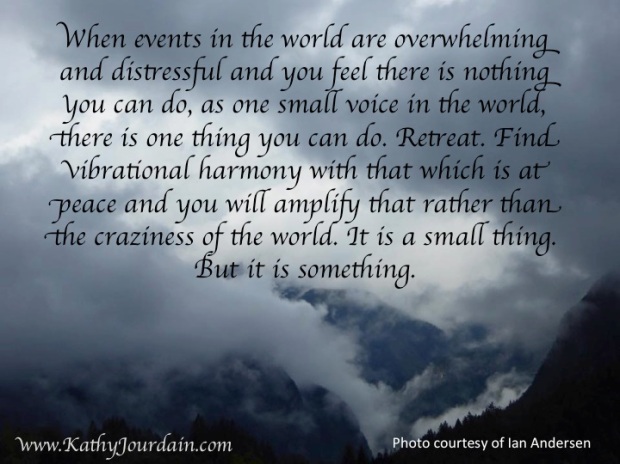
The first is to retreat. Only long enough to find vibrational harmony with that which is at peace within you, to find vibrational harmony that will allow you to act with intentionality. That action need not be large in the world. Any small step will do. Yesterday I published a post on connecting with yourself. There are some ways to do that listed here.

Small steps you could take today:

  • A moment of quiet
  • A small act of kindness for someone
  • Consciously sending love and light out into the world
  • Remember the things that bring you joy (it is okay to experience joy in the craziness of these times – in fact, it is essential, it might contribute to keeping you sane)

Today, I will post on social media mostly things that hearten me and this week I will publish as many short posts as I can focused on messages to keep us strong and openhearted.

In a world that is going crazy, we need all of us to find our internal light to shine it out into the chaos.

Standing at the Edge

Standing at the edge of the abyss

Noticing the void stretching in front of me

Nothing to hang onto

Nothing

Will it swallow me up

Drown me in the unknowing

And the fear

Or, will I stand here and breathe

Just breathe

Find my points of consciousness

Expansiveness

To flood and embrace the abyss with love

To transform it

Transform my experience of it, with it

To illuminate my fears

For the illusion they are

And become, be, love

OLYMPUS DIGITAL CAMERA

Are you holding your sadness as a treasured possession?


5-of-cups-legacy-of-the-divine2Every now and then a question shows up that captures attention as if it was lit up in flashing lights. This happened to me the other morning as I pulled my usual three tarot cards from the Legacy of the Divine deck (my favourite) to help me imagine what the story of my day could be like. One of the cards I pulled was the 5 of cups. Not necessarily a favourite, I decided to open the interpretation book to see what jumped out at me.

Why do you sometimes cradle your sadness like treasured possessions? Are you afraid that the power of your heart will shatter it and force you to leave the safety of the shadowy misery you cling to?

Sadness as a treasured possession? Shadowy misery? Crap! And wham! Both at the same time.

A while ago I wrote about what is real and what is illusion. And I’ve written about my passive aggressive relationship with the law of attraction. And about limiting beliefs.

The journey of life has a way of dishing up illusion so we imagine we are in a different place than we are. It also has a way of waking us up to reality. Like these questions.

I feel the tremulousness of these moments in my life. Partner I love deeply who lives in another country. Re-imagining our work and our businesses. Feeling the pull of life, co-parenting, scheduling. Desiring ease and not always experiencing it. Am I cradling sadness as a treasured possession? Is it part of how I define my story? It is not what I want to hear, to believe is true in this moment but there it is right in front of me.

Am I clinging to shadowy misery? Am I allowing this to define and shape the story of my life in this present moment?

What to do about it?

  1. Allow the recognition of the response evoked by the questions. Yes, there is truth there. Still. After many years of journey.
  2. Invoke compassion for myself. It is a journey. It is not right or wrong or too long. No self-recrimination, just awareness.
  3. Journal to surface and release the patterns so deeply entrenched in my being that sometimes I fear they will never be fully released and most times now I can recognize as part of the unfolding journey – the journey to openheartedness.
  4. Meditate on the vibration I am aspiring to, to let it permeate my physical and soul essence to continue to attract my dreams.
  5. Take concrete steps, even if small, to show – myself, creator, the universe – that the dream I hold is the direction in which I am moving.

I share this because I know I am not the only one cradling sadness and clinging to shadowy misery. If this resonates, know you are not alone and follow the steps.

Self Care Does Not Equal Arrogance

Love is patient, love is kind.
It does not envy, it does not boast,
it is not proud.
It is not rude, it is not self-seeking,
it is not easily angered,
it keeps no record of wrongs.
Love does not delight in evil
but rejoices with the truth.
It always protects, always trusts,
always hopes, always perseveres.
Love never fails.

The Bible: 1 Corinthians 13:4

bandaged heartIn a recent heart to heart with a friend we were talking about self-care and self-love. My friend was concerned that this would translate into selfishness and even arrogance. Fear of this was, and maybe still is, keeping him from taking care of himself, from loving himself. How many of us carry this limiting belief?

Then the verse above, from Corinthians, often quoted at weddings, came into my mind. Love is patient. Love is kind. It does not boast. This does not just apply to how we treat another we are in relationship with, but it applies to us too. To offer ourselves patience and kindness in the journey. When we  extend love and compassion to ourselves, it does not turn into selfishness or into arrogance. It turns into the openhearted journey. It makes us more aware, more powerful and invites us to embrace the fullness of our humanity. It also invites others to do the same.

Nowhere does love equate to arrogance. Nowhere. So, take care of yourself first, love yourself first., know your worth and others will know it too.

Love is the Conversation We Need To Have

Love is the conversation we need to have.  A post from Dogma to Divine I read some time ago illuminated for me the need to write about love.  Love.  Not romantic love. Not love with attachment or conditions.  Love as a way to be in the world.  Love as a way to hold space – with others, for others, for ourselves, for conversations that want and need to happen.  Love as a healing energy.  Love as a pathway in the world.  Love as an illuminator.

open-hearted (1)

Fear tries to obliterate love.  The inner voice of the judge tries to shut it down.  We have come to associate so much disappointment with love, we are afraid of love.  Afraid to let it wash over us, our relationships, our way of being in the world. We are afraid we will be disappointed, exposed, hurt.  Afraid we will be vulnerable in ways that allow others to take advantage of us, our good heart, our good intentions – in which case it is no longer love but something posing for love.

We are afraid to know ourselves from the field of love.  We are afraid to know others from the field of love.   Yet it is who we are at the core.

It is hard to love others when we do not love ourselves.  It is hard to let love in from others when we do not love ourselves.

Love is misunderstood.  We have come to attach so many conditions – or feel conditions attached –  to it that rediscovering what love is becomes a practice, a journey to open heartedness. If we allow it.  If we invite it.  We are not even aware of the conditions and the expectations we attach to it.  To those we love.  “If you loved me, you would….”  Yup.  Fill in the blank.  For anyone you are in relationship with.  We all have many of them.

If you loved me, I wouldn’t have to tell you what I feel, what I need from you.  If you loved me, you would just know.  Because you don’t know, you don’t love me.  Now I am hurt. Now I shut down.

If you loved me, I wouldn’t have to love myself.  But if I cannot love myself, I cannot let your love for me in.  I deem myself unworthy, undeserving of your love.  Not romantic love.  Human to human love.  Spirit to spirit love.  Soul to soul love.  Just love.

We discover love and how we relate to love through relationship with others.  Yes, romantic love counts here too.  And it is so much more than that.  Children. Parents. Siblings. Friends. Colleagues. Acquaintances. Strangers on the street. Those who love us.  Those who challenge us.  Those who don’t even know they impact us.  Or don’t know how much.

Disappointment arises when expectations, hopes, conditions we are carrying are not met.  When we harbour this disappointment it casts shadow over the field of love. When we replay it over and over again, it grows.  Then we feel the need to armour ourselves because we have learned love only leads to disappointment.  Anger shows up.  That we would be treated so.  That someone else doesn’t care enough about us.  That people are only mean and selfish anyway.

The journey to open heartedness invites the inquiry – into hurt, pain, grief, disappointment, attachment.  It invites the release of whatever shows up during the inquiry. It invites forgiveness.  Of self.  Of others.  An opening up of space.  Expansiveness.  Generosity.  It also invites inquiry into joy, beauty, delight and love itself.  It is a pathway to peace.   A practice we don’t get perfect but we can perfect the practice of inquiry and deepening the journey to open heartedness.

Practicing love invites us into our own vulnerability.  A vulnerability that comes from our willingness to see ourselves fully and allow others to see us.  In all of the imperfectness of who we are.  Vulnerability that invites  us to be in our strength and power.  We can be in a field of love and make different choices about different relationships. To be in some.  To not be in others.  To make conscious choices. To appreciate our choices. To make choices that invite generosity of spirit, not from a place of hurt, anger or denial – although some of the choices may start there.  We have the opportunity to shift the shape of the story at any time.  It comes with hosting self. Growing awareness.  Growing practice.

Generosity and a willingness to love others without an expectation of performance in return for love or even having that love returned in the same way.  This is a difficult practice at first.  To let go.  To not follow a path of hurt or shame.  Just to offer love.

Love is the conversation we need to have.  Now.  Always.  With each other.  With ourselves.  As we journey deeper into open heartedness, we grow our acceptance of self.  Of others in their journey, wherever they are in their journey.  It doesn’t always require words.  It can simply radiate from the heart.  Become a way of being in the world.  The more it becomes this, the more people respond, even when they don’t know that they are, or what they are responding to.  Love is the conversation we need to have.  All of us. Every where.

Originally posted on December 24, 2012 at Shape Shift Strategies Inc.

Human Tragedy Story Often Obscures Soul Journey Perspective

For a long time, I have believed we are soul journeyers having a human experience. The beauty and challenge of life is that our assumptions and beliefs get tested along the way.  In 2012, for me, one way has been through my mother’s journey.

adimirkush_Butterly

Painting by Adimir Kush

When the symptoms of my mother’s dementia were becoming more obvious in the years before she went into long term care, I knew it as a soul journey and experienced it as a human tragedy story.  This became more pronounced when she went into long term care.  Instead of being the only person in a household living out a bizarre new set of behaviours,  losing her capacity to communicate and do simple things like change the channel on the TV, she became one of many old and dying people no longer able to care for themselves, most living in their own little diminishing physical worlds.

The human tragedy story is amplified in these circumstances and places.  It is hard to see past the story of tragedy when it stares you in the face as you walk down hallways that evoke very visceral reactions in what you see, smell, hear or otherwise encounter – even in a place as loving and caring as the place my mother experienced as home in the last four years of her life.

CorridorHow many people came up to me, my brother or my father after mom’s funeral to share amazing stories about her that captured the essence of who she was and then proceeded to talk about how they just couldn’t visit her at Harbourview Haven.  How hard it was if she didn’t seem to recognize them.  How hard it is to be in that building when, as a culture, we have become disconnected from the death chapter of the life cycle.  We no longer experience it as part of the natural flow of life but as something to be feared.  Walking in a place where death is imminent generates fear and discomfort for many of us.  It did for me when I first began visiting my mother but, through my mother, the shape of my experience shifted.

For the few who were able to manage a visit or two, they expressed how amazing it was when there was a flicker of recognition in something she said.  I learned how many people besides me she called “little one” (really mom?!) and that was a point of reference for them.

There are others who saw enough through the human tragedy story to visit often.  My mother had a few of those regular visitors although we often didn’t even know it since she couldn’t remember who visited or when they did.  Deeply grateful for those dear friends.

The length of mom’s journey with dementia and her stay in long term care, invited me more deeply into this paradox of understanding  the human tragedy dressing of soul journey.   The phrase “oh, that poor soul” makes me chuckle now.  We use that phrase to describe the human tragedy perspective.  It is the physical experience that appears poor, not the soul journey perspective if you believe, like I do, that we make some choices before we manifest into physical form about what it is we want to experience for our soul journey this time around.

As my mother become more disembodied, I embodied the soul journey perspective from a deeper, more encompassing place of understanding.  Towards the end, her human tragedy story didn’t register for me anymore, only the soul journey perspective.  This gave me a high degree of peace during her long transition process, allowing me to live my life fully even while being present to my mother’s journey and our family care around it.

For the gifted people who work at Harbour View Haven, it seems to me they also see past the human tragedy perspective, treating each individual with full dignity and respect.  Treating them as if they are, what we consider, fully functioning, fully present human beings.  It was a gift to observe this most keenly in my mother’s final hours. It made me wonder what would happen if  we all treated others all the time with this kind of dignity and respect – whether we thought they deserved it, whether we thought they were fully human or not.

Living simultaneously with my mother’s journey, my journey and the rest of life, I’ve been thinking about how to express this all so it does not fuel the human tragedy story. I now speak about “the many streams of life”.  We are all in many streams of life all at the same time. Stuff happens.  Stuff comes up.  There is a life giving invitation to be well in all of it, although a more typical response is to be stressed by all the things that come our way that we have to take care.

I’m leaning into this invitation to flow with the many streams of life as though that is what they are, rather than challenges.  Greater spaciousness beautifully shows up.

And then there are the lessons of embodiment that have been present for me in a big way already in and since 2012.  As I embody my experiences and my learning I understand more deeply my life’s events, my relationships and my soul’s calling.

I’m not saying the human tragedy story isn’t real.  But the soul journey perspective is also just as real although harder for many to see, obscured by the human tragedy story.  The soul journey perspective allows me to live into joy and delight and allows me to fall in loveover and over again in a way living into the human tragedy story does not.

For my mother, I continue to experience a dance of joy, delight and lightness as her spirit soarspixies_in_the_sky-1868 free from the human tragedy unfolding of her physical body.  She continues to be my teacher and my friend and very, very real in my human experience.

(Originally published at Shape Shift Strategies Inc. on March 1, 2012)

Death and Dying – Lessons I Learned From My Mother

Originally Posted on February 16, 2012 over at Shape Shift Strategies Inc.

Never having been present at a death before, I didn’t know what to expect; and, it wasn’t what I expected.  My brother, father and I held vigil, practically holding our collective breath, as my mother, Mary Patricia Ann Ritcey Jourdain, drew her last, peaceful breaths on Wednesday, February 8, 2012, falling quiet at 12:30 pm.

Then there was silence.  Her silence.  No more rattling breaths drawn with some effort through her lungs into her ravaged body; ravaged from dementia for many years and the refusal to eat for many months.

Our silence.  In reverence for my mother, her journey and the honour of witnessing the final stages of her transition from physical form into spirit.  I already believed much of her consciousness was active in the subtle realms even as her physical presence diminished.  With her last breaths I imagined her spirit gently tugging until the last wisps of it were finally released into a delightful little dance of joy and freedom.

My mother with the beauty of youth.

My mother with the beauty of youth.

My mother’s journey with dementia was a long one.  My journey through hers was an inspired one.  Her greatest teachings for me may have been in these last few years when she could no longer string coherent sentences together, during the contrast of those times when she seemed to have no awareness of my presence to when I knew she was aware I was there.

I had one of those moments of her awareness the night before she died.  We had moved her to a special room where I could stay with her overnight.  One of her medication times was missed.  I was aware of that but she didn’t seem to be in distress. So, I sat on the arm of the couch, eye level with my mom.  I looked into her blue eyes and she held my gaze.

Summer 2008 212

Me and my mom just after she went into long term care. We posted all kinds of family pictures on the wall behind her in hopes of, I’m not sure what.

When I say she held my gaze, I really mean she held my gaze.  She was just as present as I was.  In fact, I was mesmerized.  I couldn’t take my gaze away.

So, I talked to her.  I told her about some things in my life.  I told her how beautiful she is – not was, is.  I told her how gifted she is and how loved.  I thanked her for being in my life, for being my mom.  Mostly, I held her gaze with love.  Until she began to exhibit signs of distress and I went for the nurse.  And then she was gone again until the moment of her final breath.

Four of us still in the room but now the shape of our lives fundamentally shifted.  As long as we stayed sitting in the room, it was like she was still there in her emaciated form.  But, of course, now she was free of form.  Eventually we had to move and leave her next steps in the capable hands of the Harbourview Haven staff who would transfer her into the equally capable hands of the Dana L. Sweeny Funeral Home.

The staff at Harbourview Haven taught me about human dignity and respect through how they related to my mother.  Even up to the last moment, they treated my mother as if she was fully present and aware.  They called her by her name.  In the middle of the night they would come into our room.  “Mary,” they’d say, “We’re going to turn you over now.”  “Mary, we are going to give you your meds now.  It might sting a little.”

On the morning of her death, a care worker came in to wash her face and freshen her up, providing a depth of love and care, dignity and respect to a woman in her last moments on this physical plane.  I can’t say enough for Harbourview Haven and the care they provided, not just in those last few hours but in the three years and eight months (plus a few days) that my mother lived there.  And not just care for her.  Care for my dad too.  For our family.  They understand about death and dying.  That it is a process and a transition.

My nine year old (at the time) understands about death and dying.  Enough to ask to visit his grandmother with me when I told him I was going to see her.  He hadn’t been there much lately.  I told him what his grandmother looked like and how she was.  He still wanted to come, even when the call came to say it might be her last day.  And his older brother and his girlfriend came too.  We all sat vigil the day before she died, for hours.  Watching my mother with sidelong looks every time her breathing stopped – for the eternity that shows up in a moment.

I am now aware that dying and death requires the same kind of loving care and attention as birth does.  It is birth.  Birth back to spirit.

When my older boys were young children their grandfather on their father’s side died. Their dad and I had already separated.  They went to the funeral and afterwards I asked them how it was.  We began to talk about death.  They said to me, “We think it’s kind of like this.  You know when you go to sleep and dream and when you are in the middle of a dream it seems real?  But then you wake up and you know it was just a dream.  We think life is like that.  It’s really just a dream but it seems real.  Then you die, but really it’s like waking up and realizing it was just a dream.”  Such wisdom out of the mouths of babes.  Closer to source.

I wonder how my mother might be reflecting on the 79 year dream that was her life as Mary Patricia Ann Ritcey Jourdain this time around?

Unconditional Love – A Daily Practice

Unconditional Love-Oscar Wilde Quote

To give and not expect return, that is what lies at the heart of love. ~ Oscar Wilde

“To give and not expect return.” How many of us know how to love like that? How many of us have been loved like that? We are imperfect beings in an imperfect world. We may think we love unconditionally but anytime we are disappointed by the words or actions of one we love, we may not be loving as unconditionally as we like to think.

I have been reflecting on this because it is almost Mother’s Day and there are so many posts and images that speak of a mother’s unconditional love – as though all mother’s love unconditionally, all the time. If we are lucky, we experience moments of unconditional love from our parents, as parents, as partners in a relationship, with friends we hold dear. Rarely are we loved completely unconditionally all the time; rarely do we love unconditionally all the time.

Unconditional love-nothing expected in returnWe are born with unconditional love and complete trust. As babies, we learn very quickly what behaviours and actions get rewarded and what don’t. It is a matter of survival to adapt to the expectations and conditions of people around us.

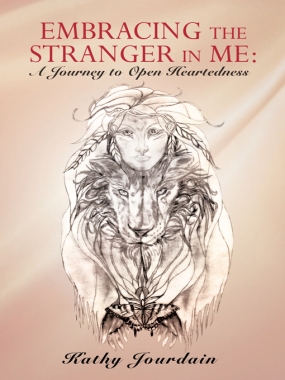
We know our soul qualities when we are very young, before we learn concepts of right and wrong, good and evil. We know our soul qualities before we build constructs around ourselves that we fool ourselves into believing are truth and essential to survival. We shape life to fit in and shape ourselves in trying to make other people happy.Embracing the Stranger in Me: A Journey to Openheartedness (p. 13)

Loving unconditionally is a practice that starts with loving self unconditionally. The more you can be in a place of loving yourself unconditionally, the more you open up the portals to receive love unconditionally. Can you love another person fully, without judgment about who they are, what they say or how they act? Then you offer unconditional love.

I have been learning about unconditional love through recognizing the times I have been “loved” with conditions – conditions that often asked me to be someone I am not, to be there for another person at the expense of myself. These relationships showed me who I was not and where I was not loving or accepting myself.

IMG_1493I have been learning about unconditional love through my cats who also come into the world loving and trusting unconditionally. They remind me of the simplicity of life.

IMG_1486

I have been learning about unconditional love through my children, the hopes and dreams I have for them to be successful in life. When we examine what that means, often we have an idea of what success means and looks like and it carries expectations or conditions we are not always aware that we are carrying. Letting go of the expectations and personal hopes for our children’s lives is an act of love. We also hold hopes and expectations for our parents and our siblings and how we want them to be in life and in relationship with us. Letting our expectations and our judgments go is an act of love that opens the way for unconditional love. And I say this in full awareness that there are some relationships that are so toxic there is no opportunity to heal them inside the relationship – just the opportunity to heal within yourself by loving and trusting yourself unconditionally.

Slide1

And I have been learning about unconditional love through my relationship with my partner and our love for each other. It is as close to unconditional as any partnership can be, infused with mutual love, honour, integrity and respect. And it is a daily practice.

Unconditional love. We get there through awareness, intentionality and practice. Daily practice.

Exposing Self: A Risk in the Journey to Openheartedness

One of the beautiful things about having written and published Embracing the Stranger in Me: A Journey to Openheartedness, is the exchange I get to have with readers deep in their own journey. This post is a result of a question from a reader.

question marks on coloured paperThe Question 

I have a whole other career inside of me that I have not exposed fully in this lifetime. Words of love and wisdom on how to get over the fear of revealing I am love? I have been abused, hurt, rejected, prejudged, all of the above…and through it all my intent is always how can I help…what can I do? I have found balance with my intent…now spirit is really telling me to move on and work though this fear.

The Response

The question you pose is a question of journey. It is the biggest question we hold as we begin to know we are on the path to allowing ourselves to be revealed. How do we give the best of ourselves without giving ourselves away, without opening the invitation to be judged, to be attacked? This is where the outer journey meets the inner journey. What is the work we need to do in and for ourselves, how do we host ourselves, in order to shine brightly in the world?

tree of abundanceHow do you learn to love yourself, not judge yourself? To be compassionate for yourself and your journey – not in a way that lets you off the hook for what you need to do but in a way that allows you to more fully explore all that needs to be explored?

Hold these questions for yourself from a place of curiosity, compassion and love. Notice the responses in you to these questions: where am I judging myself? Where I am hurting myself? What parts of me am I rejecting? What am I seeking from someone else that I have not yet found, or found in a lasting way?

What you encounter in the outer world often activates something in your inner world – your own voice of judgment or our own inner critic.

Your emotions are your guidance system. Learn to access and understand them to discover what the message is they are trying to transmit to you, how they are trying to guide you. Ask yourself: what am I experiencing in this moment? Where is it activated in my body? What is it trying to tell me/help me learn? What is it that is really bothering me? What am I really reacting to? Be in an inquiry to go deeper.

Here is some writing over on the Shape Shift Blog on what I’ve been learning that might also be helpful about your emotions as your guidance system.

And, take little risks at first, not big ones that feel like they are exposing you. You don’t need to jump in all at once – you can do it bit by bit. Start with people you feel safer with. Begin a dialog to get to deeper understanding. Seek wise counsel in the ways it wants to show up. Sometimes that might be through a friend, sometimes through a coach, sometimes through writing or experience that shows up in just the right moment. Nurture a reflective practice so you may be in some regular observance of your own experience.

designing a loved lifeYou are love, not fear. Go quiet and listen to the whispers within. Fear is ego. It is wanting to keep you safe. You can acknowledge it, thank it and explore the ways of moving into your courage, strength and power that allows you to show more and more of who you truly are.

And, we never get it perfect. We are always in our learning. Love to you in this exploration and in your openhearted journey.

All Things Are Here – In My Life and Experience – By My Invitation

When my youngest son was a toddler and a preschooler, he could throw a temper tantrum like I had never experienced before or maybe even believed possible.  He could throw them in private at home and he could also throw them in public places, equally well.  I once did my whole grocery shopping with him in a fit because my options were limited.  When he was in a tantrum, which could be set off by seemingly inane things, he was beside himself, working himself up into more of a tempest with each minute that passed. Yelling.  Screaming. Throwing himself around. He was truly inconsolable and, believe me, we tried many different ways to soothe him. Nothing worked.  Anything tried only made him worse, as well meaning friends and strangers sometimes found out.  He needed to exhaust himself from whatever swirl of emotions was in him.  When he was done, he was done.  He was ready for apple juice and a snuggle, to let go of where he had been and to move forward – almost as if nothing had happened.

I have no idea how many temper tantrums he threw.  Enough to observe a wide range of reactions and responses in myself.  Learning, as difficult as it was, he needed to be left alone, to be in his own journey of discovery of how to self regulate.  It was challenging to bear witness to and challenging as a mother to seem to have no strategies of success to help him feel better.  So many things activated in me – disappointment, frustration, my own rage, sadness, despair, feelings of failure – as a mother and a person.  Also fear when that moment became projected into the future and images of this child as a temper tantrum throwing adult made me fear he would not find his way in the world, find his way to maturity.  Learning not to personalize his behaviour, not to make it about me instead of about his experience. Learning patience, to move at the pace of guidance – one of the seven whispers in Christina Baldwin’s book of the same name.

Maybe the most significant learning was in letting go.  After what could sometimes be an hour or more of a temper tantrum, my son was ready to let it go.  An awareness and curiosity arose in me as I pondered what seems like typical adult reactions – the desire to make it about the relationship, to see it as personal attack, to want the other person to suffer as much as we perceive that we have suffered at their hands, as a result of their behaviour. “Just because you’re done, doesn’t mean it’s over. Now you need to bear the consequences of what you just did – to me.”  We want to stay grumpy even when the other person has moved beyond it.  Why do we do that? He was not angry at me.  He was not deliberately trying to ruin my day.  He was caught up in his own experience.

Staying grumpy, staying mad, seeking retribution, sometimes seeking apology, wanting the other person to admit they are wrong, are ways of externalizing our power – giving it away to someone else.  A toddler in a temper tantrum.  A person we care about in their own disruption or projection.  We want them to make it better.  We want them to pay. And who does it serve to be that way?  No one.  Especially not us. Not the relationship either.

“In my life, I have told many stories that externalize or give away my power.  Learning to own my own experience and my own power has been and continues to be a significant part of my journey.”  Embracing the Stranger in Me: A Journey to Openheartedness (Chapter 1)

Candle in hands

All of this has me reflecting on relationships – the ebb and flow, beauty and challenge that show up, sometimes in equal measure although sometimes it just seems that way, because of where we focus our attention.  When we have an argument with someone dear to us, sometimes that argument and the energetic imprint of it takes precedence and becomes the defining energy of the relationship.  If we focus on it, focus on how wronged we feel, that is what we grow.  But we have a choice.  We could choose to focus on the beauty, the joy, the qualities of the other person that we admire, adore and love.  They are there in equal measure and often more.  These could be the defining qualities of the relationship.

To know we have choice invites us into self reflection and self hosting – to discern what is our own to take care of and what needs to be taken care of in relationship, so it does not become the shadow underbelly given life by trying to repress it. This is a discernment and we may not always get it right.  But what if we could be in relationship in an attitude of appreciation, love and forgiveness?  How would that change the dynamic, flow and connection in relationship in contrast to when we focus on the moments of hurt, pain, disappointment?

I often need to remind myself that “all things are here by my invitation or attraction of them in one way or another.  If I were not attracting these experiences, the insights that arise from them could not be in my experience.  This includes people, events, situations, timing and flow.” Embracing the Stranger in Me: A Journey to Openheartedness Chapter 1.  This is the invitation to hosting myself, to be self reflective.  If I can find clarity in this, then I can know how to show up in relationship, what I can heal within myself and what I need to bring to the relationship, not through righteousness or justification but through generosity and curiosity to understand how to deepen relationship, to create the invitational space to show up in the fullness of who we both are as human beings – in our strength and our vulnerability, to not feel the need to hide or the need to defend.

“With great intentionality, I have been shifting my focus to tell more and more of the stories of appreciation, gratitude and love.  I am telling more of the stories of the way I want my life to be rather than of how I don’t want it to be.” Embracing the Stranger in Me: A Journey to Openheartedness Chapter 1.  And this is an ongoing, often daily practice.  It would be so much easier to live a cocooned life but people are always going to show up in one way or another no matter how hard we might try to shut them out.  Easier isn’t necessarily better.  The opportunity for growth shows up in those moments, invited whether we think they are or not.

A beautiful example is my son.  Not a toddler anymore.  A young person who has been learning how to self regulate his emotional experience who no longer throws temper tantrums.  Now it is a beautiful journey to witness.  He is such an old soul teacher for me in this journey to openheartedness, embracing all that shows up on the path.